US-Backed Ukraine Peace Talks Ignore Russia's Unfettered Air Assaults
Kyiv needs long range Tomahawks to raise costs for a weakened Russia, says strategist Ken Robinson
Even as Russian and Ukrainian diplomats meeting in Abu Dhabi Wednesday called their U.S.-brokered discussions on ending the war “productive,” the reality is that Vladimir Putin’s massive air attacks on civilian targets in Ukraine won’t stop until he’s faced with a higher price for continuing his brutal campaign.
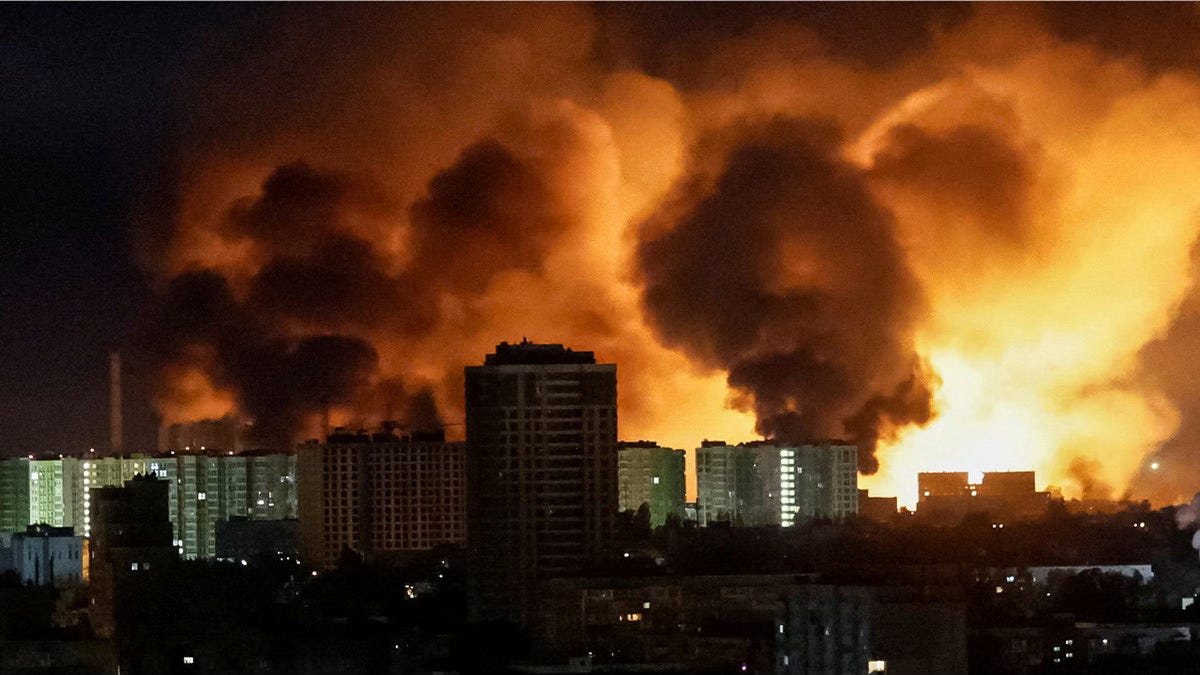
Starting Monday night, according to news reports, the Kremlin launched 71 missiles and 450 drones on civilian and energy targets across Ukraine, making it the largest assault since late December. Freezing Ukrainian cities were struck even as the two sides sat down to talk, with little evident progress on Russia’s major demand that Kyiv surrender significant real estate to Moscow.
This is no longer surprising, but it should still be clarifying. For three years, Moscow has used the language of diplomacy as cover for continued violence. Every “process” has been matched by another strike. Every pause in Western resolve has been interpreted not as restraint, but as opportunity.
This is the strategic context in which the debate over providing Ukraine with a long-range strike capability to hit strategic targets deep in Russia must finally be settled.
As Ukraine President Volodymyr Zelenskyy put it, “Without pressure on Russia, there will be no end to this war.”
For more than three years, Ukraine has fought a war it did not start against an enemy that promised victory in three days. That promise collapsed under the weight of Russian incompetence, corruption, and the simple courage of Ukrainians who refused to surrender their country.
This is not a frozen conflict. It is a war whose outcome is being shaped, day by day, by who has reach and who does not.
Right now, Vladimir Putin is weaker than he has been since the invasion began. His economy is under wartime strain. His cash reserves are being drawn down. His oil revenues, including from the so-called ghost fleet, are under increasing pressure. His industry is producing quantity, not quality. His army is increasingly made up of poorly trained recruits and coerced manpower. His generals rotate, fail, and rotate again. His logistics system is brittle. His air defenses are stretched. His rear areas are no longer sanctuaries.
\This is exactly the moment when wars are decided. And yet, at precisely this moment, parts of the West are still debating whether Ukraine should be allowed to strike the machinery of Russian war power at scale and at depth.
The issue is not escalation. The issue is whether Ukraine is allowed to win.
What must also be understood, and stripped of its theatrical power, is the “bad cop, badder cop” dynamic offered up by Vladimir Putin and Dmitry Medvedev, particularly in the realm of use of a nuclear weapon to “solve” the Ukraine impasse. This is a deliberate division of labor that dates back to their political musical chairs from 2008 to 2012, when Medvedev served as president while Putin retained real control of the state as prime minister. That arrangement never ended; it evolved.
Putin cultivates the image of the statesman, using the language of “security guarantees” and “strategic stability,” while Medvedev functions as the attack dog. He voices the regime’s most crude threats and nuclear innuendo so Putin can maintain diplomatic deniability. This is not impulsive. It is structural.
The recent threats of first use of tactical nuclear weapons fall squarely into this pattern. They are intentionally vague, tied to an undefined notion of “Russian national interests,” and left ambiguous enough to maximize fear while minimizing commitment. This is not new doctrine. It is long-standing Russian battlefield policy, performed publicly for psychological effect.
In the current theater of the absurd, where peace talks are floated even as Russian missiles continue to fall on Ukrainian cities, these statements are designed less for Washington than for Western Europe. They aim to chill political backbones, fracture consensus, and slow decision-making inside the European Union and NATO.
The West should grant these nightly talk show threats no more strategic legitimacy than they deserve. Russian generals do not set nuclear policy on television. NATO does not learn doctrine from Russian state TV. This is performance, not preparation.
Medvedev is not announcing a decision. He is playing a role.
Which returns us to the real question facing the West: not what Russia says, but whether Ukraine is allowed the reach to end this war on the battlefield.
Show Me
The weapon that crystallizes this debate is the Tomahawk cruise missile.
Tomahawk is not a terror weapon. It is not an indiscriminate weapon. It is one of the most precise, reliable, and well-understood long-range strike systems ever built. For decades, the United States has used it to dismantle enemy air defenses, destroy command nodes, and cripple logistics networks while minimizing civilian casualties. It is a tool for turning an enemy’s rear areas from a sanctuary into a liability.That is exactly what Ukraine needs.Wars are not decided only in trenches. They are decided in rail hubs, fuel depots, ammunition storage sites, repair facilities, command centers, air bases, and choke points (not to mention America’s AI labs). Russia’s entire war effort depends on a sprawling, fragile logistics system that stretches from the front line deep into occupied territory and into Russia itself. Every day that system survives, Russian forces can keep fighting. Every day it is disrupted, Russian combat power shrinks.
Ukraine has already shown what happens when it is given even limited reach.
With a mix of indigenous drones, Western-supplied missiles, and extraordinary intelligence work, Ukraine has struck air bases, ships, bridges, oil facilities, and headquarters. The results are not symbolic. They are operational. Aircraft are destroyed. Ships are sunk. Fuel is lost. Repairs take months. Morale suffers. Command and control is disrupted.
Behind many of these strikes is a quiet, professional intelligence war.
Ukraine’s security services, working with networks inside occupied territories and even inside Russia and Belarus, have built a targeting picture that would be the envy of many NATO services. They have demonstrated discipline in target selection and real care to avoid civilian casualties. Their strikes are aimed at military objectives: depots, bases, factories, command posts, and transport nodes.
This stands in brutal contrast to Russia’s campaign of indiscriminate attacks on Ukrainian cities, power stations, and apartment blocks. One side is fighting a modern, intelligence-driven war against military targets. The other is committing war crimes as a matter of routine.
Negotiation only makes sense when both sides believe they cannot improve their position on the battlefield. Right now, Russia still believes time is on its side (and the Trump administration is allowing it that). Its belief is sustained not by strength at the front, but by the relative safety of its rear.
The Tomahawk changes that.
Going Deep
With Tomahawk-class reach, Ukraine could systematically dismantle the deep infrastructure of Russia’s war: major logistics hubs, key rail junctions, critical fuel and ammunition depots, repair and overhaul facilities, and high-value command nodes far beyond the current strike envelope. This would not be about theatrics. It would be about methodically reducing Russia’s ability to sustain large-scale operations.
Tactically, it would mean fewer Russian shells, fewer Russian missiles, fewer repaired vehicles, and fewer sorties from Russian air bases—virtually all of which are killing Ukrainian men, women and children in their homes, apartments, shops, and cars, not military targets. Operationally, it would force Russia to disperse, harden, and defend a rear area that is far too large to protect effectively. It would stretch air defenses even thinner. It would slow movement, complicate planning, and increase friction everywhere in the system.
Strategically, it would make clear to the Russian elite and to Russian society that this war has no safe depth and no painless continuation. The war would no longer be something that happens “over there.” It would be a constant, expensive, exhausting drain on the entire state.
Some argue that giving Ukraine weapons like Tomahawk is “too provocative.” This is the same argument that was made about Javelins, about HIMARS, about Patriots, about ATACMS, and about F-16s. Each time, the line moved. Each time, Russia adapted. Each time, the war continued. And each time, Ukraine proved it could use advanced systems responsibly and effectively.
There is no magic line that, once crossed, suddenly turns Russia into something it is not already doing.
Russia is already waging a total war against Ukraine. The only question is whether Ukraine is allowed to wage an effective one in return.
There is also a moral dimension that should not be avoided.
Ukraine has paid for this war in blood and in cities. It has defended not only its own independence, but the principle that borders in Europe are not changed by force. To now pressure it into political concessions for things Russia could not achieve on the battlefield would be a historic shame.
If the West forces Ukraine into a bad deal now, after all this sacrifice, it will not end the problem. It will freeze it. Russia will rebuild, rearm, and return. In five or ten years, we will be paying for the same ground again, with more lives and more risk.
There is a better path.
Give Ukraine the tools to finish the job.
Give it the reach to dismantle the Russian war machine, not just to blunt it at the front. Give it the ability to turn Russia’s depth into a liability rather than a refuge.
Tomahawk is not about escalation. It is about the conclusion.
This is the moment. Putin is weaker. His system is strained. His army is hollowing out. His supply chain is vulnerable. His revenues are under pressure. His society is tired, even if it is afraid to say so.
If we do not act now, we will look back on this as the moment we chose delay over decision, caution over victory, and process over outcome.
Ukraine has earned the right to win this war. Not to survive it. Not to freeze it. To win it.
Denying them the means to do so would not be prudence. It would be a failure of nerve, and a stain on the West that history would not forget.


Executive branch: Trump and his administration are actively considering whether to allow Tomahawk cruise missiles to reach Ukraine, but no formal approval has been issued. The decision appears tied to strategic concerns and broader diplomatic goals.
Legislative branch: Some lawmakers support supplying Tomahawks, but Congress has not passed mandating or funding authorization solely for that purpose. The authority to provide them still rests mainly with executive export/sale approval unless Congress legislates otherwise.
Alternatives: The U.S. is advancing other long-range cruise missile support like ERAM, which may sidestep restrictions on Tomahawk transfers.
One more thing from the Epstein files: "Former MI6 spy claims Epstein had Russian ties and ‘kompromat’ on Trump Camilla Jessen" And we may be finding the true extent of a spy net that the Soviets started in the USA in WWII or even before in WWI. I have thought much of our Congress was motivated by fear of threats. Now it seems tha "honey traps" run by Epstein may have done the trick(s). A long shot. But certainly worth looking at after all we have seen in the White House and our Ukraine moves.