

Why Greenland? Why Suddenly Now?
Trump is needlessly accelerating a Game of Nations in the Arctic’s melting ice, writes strategist Ken Robinson

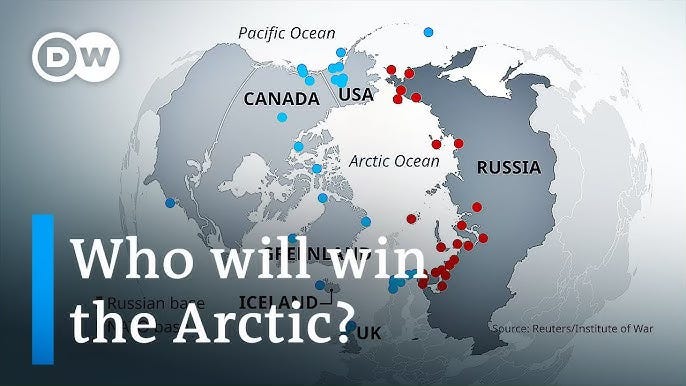
For two centuries now, the so-called “Great Game of Nations” has been centered on the shifting boundaries of Central Asia and its surrounding regions, with Great Britain and Russia, later joined by the United States, China and Turkey, vying for power.
Suddenly, In an historical blink of an eye, that focus has changed. Today, supercharged by the ambitions of President Trump, it’s the Arctic. And the lineups of friends and enemies have been scrambled beyond recognition.
For most of modern history, the Arctic was not a battlefield. It was a barrier—a frozen lid on the top of the planet that separated continents and contained the shortest, most dangerous flight paths of the Cold War.
During that era, the Arctic’s strategic meaning was almost entirely military and almost entirely vertical. American and Soviet bombers, and later ballistic missiles, could cross the pole on the shortest route between civilizations. The Arctic was not a marketplace. It was a warning system. Radar lines, under-ice submarine patrol routes and remote U.S. air bases like Thule (now Pituffik Space Base) in Greenland existed for one reason: to detect and survive the opening minutes of a nuclear war.
That world is over.
Today, the Arctic is not a lid. It is becoming an ocean.
As polar ice retreats, geography itself is changing. Sea routes that were once seasonal fantasies are becoming commercially viable: Russia’s Northern Sea Route, Canada’s Northwest Passage, and eventually transpolar routes straight across the top of the globe. At the same time, what lies beneath the ice is coming into play: oil, natural gas, rare earth minerals, critical metals, fisheries, and strategic port sites.
When geography becomes valuable, power follows.
The Arctic is no longer a buffer. It is becoming a prize.
There are eight Arctic states, but five matter most strategically: the United States, Russia, Canada, Denmark (through Greenland), and Norway. Each sees the region through a different lens, but all now see the same thing: opportunity mixed with risk.
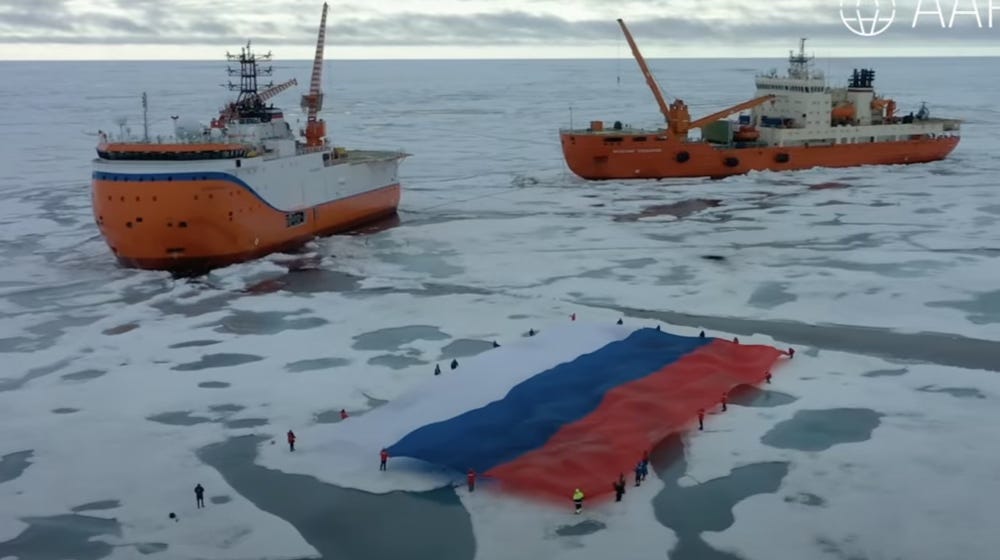
Russia is the most aggressive and the most prepared. It has rebuilt Cold War-era bases, commissioned nuclear-powered icebreakers, created Arctic army brigades and declared the Northern Sea Route a strategic national artery. Moscow is not simply defending territory. It is attempting to turn climate change into geopolitical leverage, converting the Arctic into both a resource platform and a fortified bastion for its Northern Fleet.
Canada approaches the Arctic primarily through sovereignty, especially control of the Northwest Passage, which Ottawa considers internal waters. The United States and most maritime powers view it as an international strait. This is not a semantic dispute. It goes to the heart of freedom of navigation, one of the central pillars of the postwar international order.
Norway anchors NATO’s northern flank, watching Russia’s strategic submarine force across the Barents Sea. Denmark’s role flows from Greenland and the Faroe Islands, which sit astride the air and sea lines between North America and Europe. And then there is the United States.
The United States does not need to “take” Greenland to protect its security interests. That question was settled more than seventy years ago.
After World War II, the United States and the Kingdom of Denmark signed binding defense agreements, most importantly the 1951 Defense of Greenland Agreement under NATO. That framework grants the United States the legal right to operate militarily in Greenland for collective defense. It remains in force today and is the legal basis for the long-standing American presence at Pituffik Space Base, which is central to missile warning, space surveillance, and Arctic defense.
In plain English: U.S. military access to Greenland has been guaranteed since the early Cold War.
What has changed is not the legal framework. What has changed is the strategic environment—and suddenly, Trump’s hardening threats to take it by force.
Above and Below
Russia is back in the Arctic in force. China, though not an Arctic state, has declared itself a “near-Arctic power” and is probing for economic, scientific, and eventually strategic footholds. Beijing’s interest is not symbolic. It is about resources, shipping routes, port access, undersea cables, and long-term leverage in a region that will matter more with every passing decade.
Denmark has been a valued ally, but it does not have the independent capacity to secure Greenland against great-power competition at this scale. That is not a criticism. It is a fact of geography and resources.
What the United States is doing now is not conquest—yet. It is positioning.
Positioning to deter adversarial expansion. Positioning to secure Arctic trade and resource corridors. Positioning to protect allied territory, if not under an existing legal framework, then through other means. Positioning to ensure the Arctic does not become a strategic vacuum.
The legal backdrop matters. Under the UN Convention on the Law of the Sea, states can claim exclusive economic zones out to 200 nautical miles and, in some cases, extended continental shelf rights beyond that. This has produced overlapping claims in the central Arctic Ocean, including around the Lomonosov Ridge, by Russia, Canada, and Denmark. These disputes are being fought today with survey ships, lawyers, and map submissions rather than warships. For now.
But law only works when power enforces it.
Today, the Arctic is not a lid. It is becoming an ocean.
Another missing piece in much of today’s debate is freedom of navigation. The United States has a permanent interest in preventing any power from turning the Arctic’s emerging sea lanes into private toll roads. Whether the issue is Russia’s attempts to control transit along the Northern Sea Route or disputes over the Northwest Passage, the principle is the same: global trade routes must remain global.
During the Cold War, the Arctic was the roof of the world’s most dangerous house. You worried about what might fly over it. In the twenty-first century, it is becoming a crossroads.
Energy flows. Data cables follow. Shipping lanes shorten the distance between Asia, Europe, and North America. Minerals that modern economies cannot function without are being surveyed, mapped, and claimed. Ports that barely existed are being transformed into strategic hubs.
The ice is melting. The maps are being redrawn. The lawyers have arrived. The soldiers are quietly returning.
The Arctic is no longer a backwater.It is where the twenty-first century’s balance of power is being negotiated in slow motion.
The great game is not coming.
It has already begun.
Trump, Greenland, and the Real Issue
There is a great deal of commentary about Trump “wanting to buy Greenland”—if necessary at the point of a gun. Most of it—and his own rhetoric about “owning” versus “renting”—misses the strategic point.
The United States does not need to own Greenland to secure its interests there. It already has what matters: legal, treaty-based military access that has existed since the early Cold War.
The 1951 Defense of Greenland Agreement between the United States and Denmark, embedded in NATO’s collective defense structure, gives Washington the right to operate, build, and maintain military facilities on the island. That is why the U.S. has operated there continuously for decades, and why Pituffik Space Base remains one of the most important early warning and space surveillance nodes on the planet.
Trump’s inarticulate posture about Greenland “conquest,” delivered in something closer to a Pablo Escobar-style “silver or lead” offer, is in fact an expression of anxiety about what he perceives as Greenland’s strategic drift. He sees Denmark’s exploration of Chinese commercial investment proposals as a near term threat. Whatever the merit of that view, the United States will not tolerate a Chinese foothold on Greenland.
As Russia and China increase their Arctic activity, Greenland’s strategic value rises. The real issue is not ownership. That’s fatuous. It is ensuring that Greenland never becomes a weak link or a strategic vacuum in a region that is becoming contested.
In strategic terms, reinforcing U.S. and allied control of Greenland is not radical. It is simply the continuation of a policy that began after World War II. The question now is whether destroying NATO by invading it makes any sense. Outside of Russia, China, North Korea and Iran, no one thinks it does.
Ken Robinson is a former U.S. Army Ranger and Special Forces officer with deep experience in intelligence, irregular warfare, crisis operations and Track II diplomacy. He is also CEO and Executive Producer of Oppida Global Media, a Television & Motion Picture production company in Beverly Hills, California.
Good, sensible, and thoughtful analysis. If President Trump lightened up on the rhetoric, I’m sure he’d get what he wants.
Keep up the good work.
There is a far simpler way to understand Trump's press to acquire Greenland, than that it is some deceptively clever geopolitical strategy to achieve a number of subtle ends that will only be revealed in the decades to come. Then we'll be able to say, "That Donald Trump, he was one sneaky tactical and strategic guy! Wow!"
No, the far simpler explanation is that Trump is bonkers.
It doesn't make any sense to rattle sabers at Denmark. If Trump stormed Copenhagen today and said, "We demand that you permit us to establish 10 bases on Greenland, dredge a new port on the east coast of Greenland, and place 25,000 troops on those bases!", do you know what Denmark (and Greenland) would say?
Denmark and Greenland would say, "sure, why not. let's work out the details, it'll be great."
It was the US which *unilaterally* has been emptying its ten or so Greenland bases in the past 40 years. It's not like Denmark kicked us out. Denmark would probably *like* to have a US-paid-for military presence on Greenland. All we have to do is say, "would this be okay?" and Denmark would simply say, "of course."
The simplest explanation of all of this present smoke and noise is that Trump is bonkers.
Don't make this more complicated than it needs to. be.