

Was Ahmadinejad an Israeli Agent?
The New York Times reveals a bizarre US-Israeli regime-change scheme to return former hardline Iranian President Mahmoud Ahmadinejad, rumored to be a secret Israeli agent, to power.

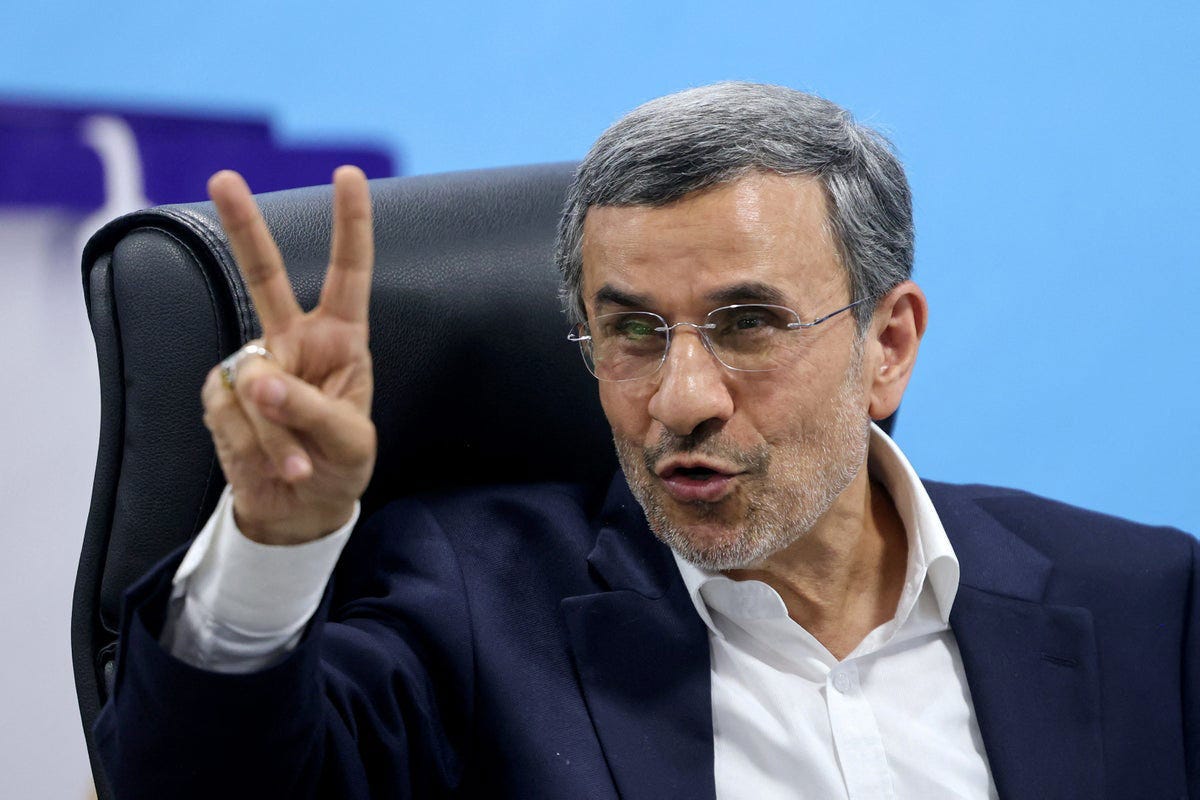
Cascades of shock, astonishment, disdain, intrigue and speculation swirled Wednesday over a blockbuster report that Israel plotted to return former hardline Iranian leader Mahmoud Ahmadinejad to power as part of its regime-change plan for Tehran in the first days of the Iran war.
“This is without doubt one of the craziest stories I have ever covered, if not topping the list,” said Ronen Bergman, a member of the New York Times reporting team that broke the story of high level intrigue late Tuesday night, in a note to his followers accompanying his distribution of the piece.
The plan, according to sources who spoke to the Times, was for U.S.-Israeli air strikes to decapitate the regime’s leaders and at the same time kill off guards keeping Ahmadinejad, who’d fallen out of favor with Ayatollah Khamenei and senior leadership, under virtual house arrest. With the former president freed, then, supposedly, Kurds armed by the U.S. would be mobilized to invade Iran and head toward Tehran, where they’d add to the unrest and help topple the government. Ahmadinejad, widely rumored inside Iran to be a secret Israeli asset, an expat expert told SpyTalk, would then take power.
“[T]he Israeli plan foresaw a combination of influence campaigns carried out by Israel and the Kurdish invasion creating political instability in Iran and a sense that the regime was losing control,” reported the Times. “In a third stage, the regime, under intense political pressure and the weight of damage to key infrastructure like electricity, would collapse, allowing for what the Israelis referred to as an ‘alternative government’ to be established.”
The scheme seemed laced with mind-boggling paradoxes and intrigues. The new regime would be headed by Ahmadinejad, whose two terms as president, from 2005 to 2013, were marked by a severe crackdown on political dissent, an expansion of uranium stocks, and inflammatory rhetoric directed at the U.S. and especially Israel, which he would only refer to as a “Zionist regime” that had to be “eliminated.”
Since then, however, his views had dramatically softened, says Hooman Majd, an Iranian-born American journalist, author, and political commentator focused on Iranian affairs, who served as a translator for Ahmadinejad on his trips to the United Nations.
“Over the last few years, he had sort of changed his stance on being anti-Zionist. He even gave an interview to an Israeli newspaper, for example, which is a big no-no for an Iranian politician,” Majd, author of The Ayatollah Begs to Differ: The Paradox of Modern Iran and other books on the regime, told SpyTalk in an interview. “There is not a single Iranian politician who’s ever done that, and certainly no Iranian president would ever do that, former or otherwise”—which prompted questions about his loyalty and eventually led to what amounted to his house arrest and jailing of his political aides.
Suspected Treachery
Rumors swirled that Ahmadinejad was not just disenchanted with the regime of Ayatollah Ali Khamenei but had been secretly working for Israel all along, Majd said. The whispered, convoluted reasoning went that his extremist presidency, which had effectively derailed warming relations with the U.S. and Europe under his predecessor Mohammad Khatami, served only to bolster Israeli Prime Minister Benjamin Netanyahu’s campaign for regime change.
“He goes around denying the Holocaust, saying Israel needs to be erased from the pages of time…there are no gays in Iran, things like that,” said Majd, who also served as an adviser and interpreter for Khatami on his trips to the U.S. and U.N. “I mean, it benefited no country more than Israel and harmed Iran to a great degree in its international standing.” And “no one used that more,” said Majd, “especially after the nuclear negotiations [began with the U.S.] than Bibi Netanyahu.”
“The rumors [had] been around from day one,” added Majd, “even in the first year of his presidency—rumors inside Iran among the Iranians that he was a Mossad asset.” Ahmadinejad’s trips to Hungary and Guatemala, both friendly to Israel, spurred talk of his possible treachery.
“It sounds implausible,” Majd granted, “but a lot of people had a hard time reconciling his words with how it would benefit Iran. You know, Holocaust denial—how does that benefit Iran?” The country became more and more isolated internationally under the diminutive president, who became an object of scorn and ridicule on many of his foreign trips.
Another wrinkle of intrigue: “You could also argue that it wasn’t a direct recruitment by Mossad, that he didn’t even know he was being manipulated,” said Majd. “Intelligence agencies have ways of doing that.”
If true, the astonishing degree of Ahmadinejad’s treachery (or his naivete) beggars belief. Why would he succumb to such a thing?
“Well, power,” said Majd, the descendant of pre-revolutionary Iranian diplomats who was educated in private schools in the U.S. and England. The former president had become a marginal political figure, at best, in Tehran.
“The question now really is where is Ahmadinejad? Is he dead? Is he in jail in Iran? I mean, after this story, if he wasn’t under surveillance or in jail, he will be now for sure.”
Deposed, Disposed
The Times reported that Ahmadinejad “was injured on the war’s first day by an Israeli strike at his home in Tehran that had been designed to free him from house arrest,” according to American officials and an associate of Ahmadinejad. “He survived the strike, they said, but after the near miss he became disillusioned with the regime change plan.”
“If he backed out, it seems Israel would want him done,” said Majd. In any event, the leak in the Times effectively signs his death warrant.
“It’s possible Israel thinks he played them,” Majd said. “Either way, eliminating him would not be out of character [for the Israelis], once he was not willing or unable to do what was promised.”
The whole idea of installing Ahmadinejad with the help of an armed Kurdish force that could defeat the Iranian military and security forces struck other close observers as delusional. According to a deep–dive Times report back on April 7, some top Trump officials derided Netanyahu’s assurances about regime-change as delusional.
CIA Director John Ratcliffe called it “farcical.” Secretary of State and National Security Adviser Marco Rubio called it “bullshit.” Vice President JD Vance “also expressed strong skepticism about the prospect of regime change,” according to the Times.
“All these ideas testify to a profound lack of understanding of the Iranian system and an underestimation of the Islamic Republic’s strength,” commented Danny Citrinowicz, former head of the Iran branch of Israeli military intelligence, in reaction to the Ahmadinejad story. “But the problem is not just that we tried and failed; in fact, we created a reality far worse.”
“Mahmoud Ahmadinejad’s only chance of rising to the top in Iran would be managing a civil war among the leadership, because he is so universally despised by both reformists and conservatives,” Meir Javedanfar, the co-author (with Yossi Melman) of The Nuclear Sphinx of Tehran: Mahmoud Ahmadinejad and the State of Iran, told Israeli TV. On X, he opined that the Times story “is a disinformation campaign initiated by those that tried to assassinate him,” meaning the Israelis. “This is an assassination attempt gone wrong. It failed. So now disinformation is being used to create chaos within the ranks of the Islamic Republic of Iran.”
And so, like many an espionage leak, the true story may lay buried in layers of deception for decades, if not forever.
One detail in particular argues that, as The New York Times has reported, Israel actually counted on engineering regime change in Iran by installing Mahmoud Ahmadinejad as the new head of government. The Times recalls that in a 2019 interview with the paper Ahmadinejad spoke admiringly of Donald Trump, praising him as “a man of action” capable of a businessman’s cost-benefits analysis in approaching negotiations and thus implicitly logical partner in fashioning a rapprochement between Teheran and Washington. Such a perspective would have seriously commended Ahmadinejad to Netanyahu and his Mossad coup makers since it meant that they could easily sell their regime change scenario to egoist Trump. This in itself suggests the Israelis were indeed dead-serious about putting this unlikely guy in charge and that all the noise about it now is much more than mischief-making disinformation on their part to sow confusion within Iran’s battered paranoid leadership. Also, for Trump, embracing a half-nasty like Ahmadinejad would have fit the scenario he followed in Venezuela where Maduro’s one-time deputy now holds sway thanks to the US.
Incredible content. It's why I subscribe to this forum/substack.