

The Spies and Professors Who Saved Ancient Athens from Nazi Plunder
“The American School of Spies” is an engaging tale of how anti-fascist Greeks hid their antiquities with help from Allied agents

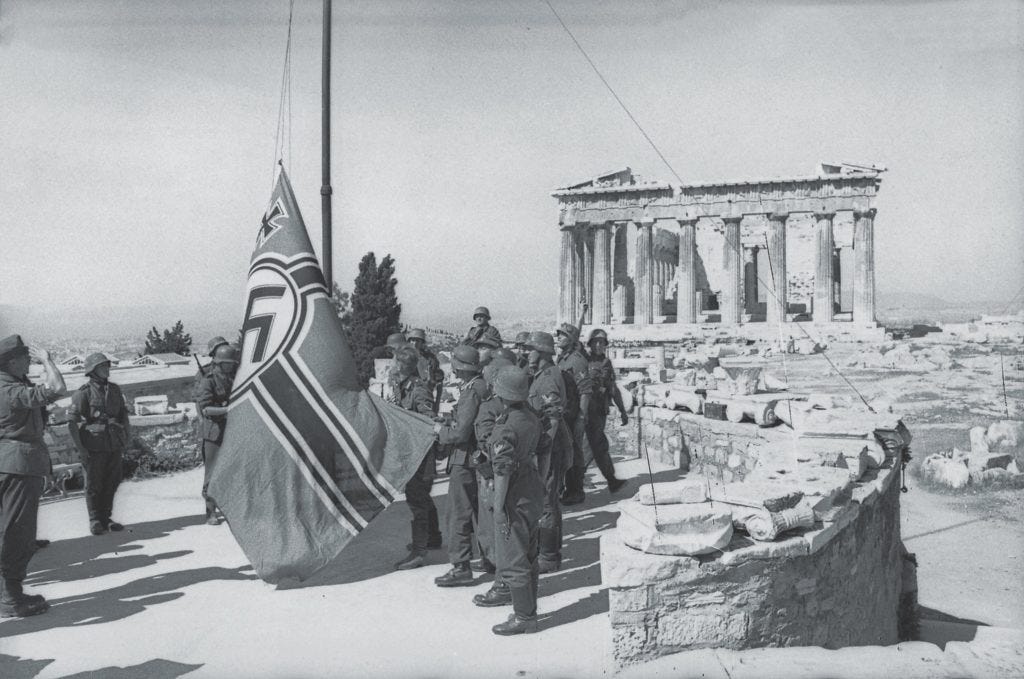
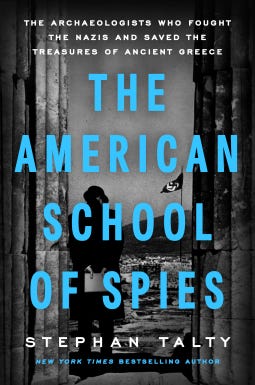
Beyond a thirst for global domination, ambitious strongmen share a desperate need to manipulate history to bolster their legitimacy. This obsession with the past is at the heart of Stephan Talty’s compelling new book, The American School of Spies, The Archaeologists Who Fought the Nazis and Saved the Treasures of Ancient Greece.
As the Wehrmacht swept across Europe during World War II, Adolf Hitler obsessed over a fantasy: that his “Aryan” race had its true roots with the gods of ancient Greece. This unfounded belief was the cornerstone of “Germania,” a colossal reimagining of Berlin intended to be the capital of a Thousand-Year Reich, a city of classical-themed statues, arches and monuments—a despot’s plan for a permanent memorial to himself.
When his onslaught across Europe reached Athens in April 1941, Hitler dispatched teams of German archaeologists across the Greek archipelago to search for proof of their Aryan soul. (“Aryan” is an ancient Sanskrit term meaning “noble,” or “civilized,” which became popular among white 19th-century European racial theorists.)
“The Nazi classicists,” writes Talty, “set to work, digging their pickaxes into the Greek soil in order to finally prove that ancient Greece had been founded by Aryan people.”
Along the way, German soldiers were free to pillage whatever they could find. However, the Nazi onslaught faced significant challenges. Greek patriots were ready for them, and soon agents from the United States and Britain pitched in as well. The heroes are many in Talty’s story—common folk joining forces with professors and archaeologists drafted to fight an unconventional war.
The American School of Spies details the triumph and ingenuity of a proud people aided by the Allies. In this little-told story of the war, Greece was far from a sideshow. The battle there was intensely real, though subsumed in the day-by-day news of big-unit combat in France, Italy and beyond. Talty makes a convincing case that the war in Greece played a significant role in defeating Germany, while weaving in an entertaining narrative about blocking Nazi attempts to steal its patrimony on a dictator’s wild whim.
The Acropolis could well have been plundered beyond recognition or destroyed in the fighting. When the war was over, “the spies, the numismatists, the curators, and the Greek-American commandos who had fought near this hill knew another side of the Acropolis—of disaster narrowly averted,” writes Talty, a journalist and author whose most recent book is Koresh, about the Branch Davidian cult leader and the disastrous 1993 FBI assault on his commune in Waco, Texas. His book with Richard Phillips, A Captain’s Duty, about a Somali pirates’ raid on a U.S.-flagged cargo ship, was turned into the film Captain Phillips, with Tom Hanks in the title role.
As Talty notes, Athens was more than a symbol. Occupied by fascist troops, the city could have been ravaged.
Hiding the Valuables
Many elements prevented that from happening. First, the Greeks prepared an extraordinary plan to forestall the assault on their antiquities. Officials of the National Archaeological Museum in Athens undertook months of back-breaking work to hide their greatest treasures. Using pickaxes and shovels, they dug deep into the basement of the building--a monumental effort involving civil engineers, artists and workmen.
“Many of the statues and the relics and the frescoes that carried the ancient culture had come close to vanishing,” Talty says.
Talty captures the scene vividly:
“A chemistry professor from the local university came by to take a look at the Ephebe of Marathon, more commonly known as Marathon Boy, a bronze sculpture that had been hauled out of the Aegean in 1925. It and the other large bronzes were wrapped in tar paper to protect them from moisture and placed in wooden boxes. Ironically, during the excavation, a cache of broken pottery was discovered under the museum. In the act of hiding relics, the workers had found more.
“This was Greece.” the author says, the essence of the nation.
When they were done turning the museum foundation into a unique burial ground, they topped it off with a cement slab. When the Nazis took over in April 1941, the occupiers were flummoxed: the National Archaeological Museum was empty.
Talty writes that the Nazi commander in charge marched up to the museum director and demanded: “Where are the artifacts?”
At first, “the director said nothing. The burial operation had … finished only ten days before; the concrete laid over the trenches was still curing.” When the officer repeated the question, the director offered a reply that defines the Greek spirit. “‘Antiquities are where everybody knows they are,’ the director said. ‘Under the ground.’ The German didn’t seem to get the joke, which was not quite a joke.”
Meanwhile, William “Wild Bill” Donovan, head of the Office of Strategic Services (OSS), had identified the German occupation of Greece as a linchpin in combatting and slowing down the Nazi advance in Europe. He recruited American archaeologists who had worked for years in Greece and knew the culture intimately.
He chose Rodney Young, an East Coast blue-blood and heir to the Ballantine Beer fortune, to lead an operation that combined elements of intelligence-gathering and sabotage. Running the OSS Greek desk from Cairo, Young became a real-life Indiana Jones. He recruited other archaeologists and a network of Greek-Americans—children of immigrants who pridefully volunteered to show their patriotism for both their old and new worlds.
“This was Greece.” the author says, the essence of the nation.
“If the war was a chance for native Greeks to wring centuries of slavery and occupation out of their bloodstreams, it was for Greek Americans a chance to show they measured up,” writes Talty. “The OSS wanted mechanics, radio operators, safecrackers, pigeon trainers (for delivering messages), medics, and commandos.”
The mission extended far beyond hiding antiquities. Saboteurs destroyed weapons caches and staged attacks intended to bog down the Nazi forces, forcing them to maintain a presence in Greece--which, in a small part, helped draw Berlin’s attention away from the impending Allied assault on Normandy.
While the fight for artifacts was waged in the soil, an equally consequential shadow war was unfolding in the diplomatic corridors of nearby Turkey. At the center of the intrigue was Elyesa Bazna, code-named Cicero, a German agent who had worked first for the U.S. military attaché and then the British ambassador in Ankara. Young’s OSS Cairo desk extended to Turkey and the region surrounding Greece, but he missed catching Cicero, who was passing crucial Allied military plans to Hitler. A security team realized there had to be a mole in Ankara and took a look at Bazna, but let him go.
“The security agents invited Cicero in for tea, during which they asked him for sugar, speaking in German. Cicero adroitly answered that he didn’t speak German, and the spy catchers dismissed him, thinking he was ‘too stupid to make a good spy.’”
Far from stupid, Cicero purloined information that showed the real planning behind the upcoming allied invasion of Europe. But there was stupidity on the other side, too: Hitler and his inner circle thought the intelligence was too good to be true.
Nazi officials, “including Hitler, wavered on Cicero,” Talty relates. And that is a recurring problem with intelligence: The more fantastic it seems, the harder it is to believe. The information he provided was so good, the Germans suspected he might be a double agent and dismissed his warnings. Ironically, writes Talty, “if Cicero had been more discerning or simply less productive, he might have been taken more seriously.”
A real German double agent for the Allies, however, passed along her suspicion that Cicero was indeed the real thing and a major security threat. Cornelia Kapp was the daughter of a German Abwehr (military intelligence) agent who had cover as a diplomat. Kapp had grown up in Cleveland while her father was assigned to the consulate there in the 1920s. An OSS informant, Kapp landed a job as a secretary in the German embassy in Turkey and began passing along Nazi secrets to the Allies.
The dangerous interplay between Cicero and Cornelia could have changed the outcome of the war. If Cornelia had been caught and interrogated, “one thing would have been clear to the Germans: Cicero was not a double agent,” and his intelligence on Allied war plans would have been reviewed by Berlin and deemed authentic.
As in the case of Cicero and Cornelia, the human factor proved decisive. Hitler became increasingly erratic as his armies retreated. He ordered his commander to destroy Paris and flood Athens by blowing up the U.S.-built Marathon Dam 28 miles to the north.
“The flood would have sluiced along a natural drainage path southwest toward Athens,” Talty explains. “It would have destroyed farms, swept up farmers, and drowned families in their cottages…Thousands would have died.”
It was here that the unique skills of Talty’s protagonists proved most valuable. Nazi General Hellmuth Felmy agreed in negotiations to countermand Hitler’s orders in exchange for a safe retreat. He sent sappers to the dam to remove the explosives rather than detonate them.

Today, as we watch modern authoritarians once again weaponize history and target cultural heritage for their own glory, Talty’s book feels less like a retrospective and more like a warning. It reminds us that while strongmen may try to bury the truth, it rarely stays underground.
Upon their liberation, the Greeks ripped up the concrete floor and restored the Marathon Boy, a third century B.C.E. Bronze, and all the other ancient statuary, to their rightful places.
Hitler’s Germania remained a fever dream. In the end, der Führer’s fate mirrored Percy Bysshe Shelley’s “Ozymandias,” whose quest for classical glory fell to dust, leaving only “a colossal wreck, boundless and bare. Nothing beside remains.” The statues— and democracy itself—were saved by the very people the dictator sought to erase.
SpyTalk Contributing Editor Peter Eisner is an award-winning reporter and editor, formerly at The Washington Post, Newsday, and The Associated Press. He is the author of a nonfiction trilogy about World War II: The Freedom Line, The Pope’s Last Crusade, and MacArthur’s Spies.
This is very interesting. It definitely resonates, today. I look forward to a new book once I finish the other two I have that were recommended here. Thank you for your service.
Great story about saving Greek antiquities from the Nazis. Ironic though that it was the Brits who had long before plundered the Elgin Marbles, and who are still sitting on them, refusing to release them back to their home.