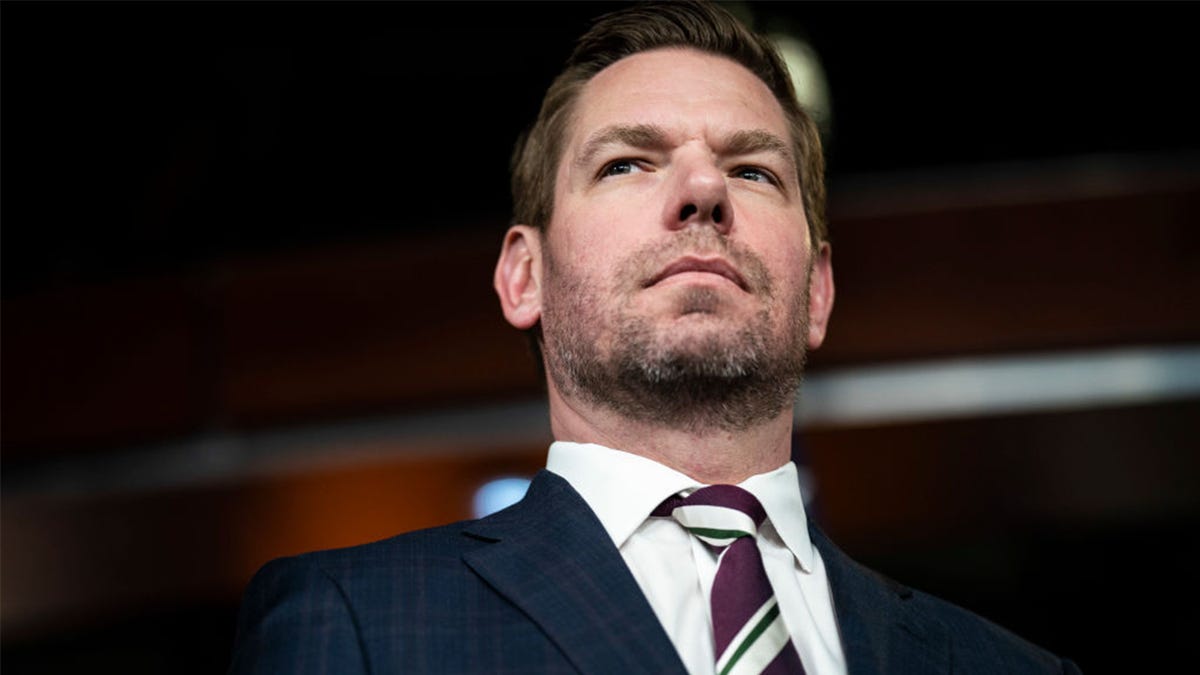
The Education of Eric Swalwell
The disgraced congressman had a close call with a Chinese agent in 2015, but the lesson on indiscretion evidently never took. It was worse than that, women say.
MANY WASHINGTON SEX SCANDALS AGO, I asked a retired former head of FBI Counterintelligence what the bureau did when it discovered the KGB or other malefactors making inroads with a member of Congress. A couple of FBI agents, he said, would make a discreet visit to the Hill and let the member know that their new friend was actually a spy. Then it was up to him or her what to do about it.
Eric Swalwell, the now former candidate for California governor and soon-to-be ex-congressman, did the right thing when “U.S. intelligence,” according to reports, told him in 2015 that a political fundraiser known as Christine Fang, who had placed an intern in his office, was a suspected Chinese spy. The FBI was particularly concerned, of course, because Swalwell had a seat on the House Intelligence Committee. He cut off contact with her and briefed the FBI on everything he knew about her, according to reports.
“Swalwell was completely cooperative and under no suspicion of wrongdoing,” an unnamed FBI official familiar with the investigation told the San Francisco Chronicle. A House Ethics Committee investigation cleared him of wrongdoing but the affair eventually cost him his seat on the Republican-controlled intelligence committee.
But Swalwell evidently failed to learn a more vital lesson from the experience: Don’t do anything that you wouldn’t want made public. Put more harshly: Don’t do anything that leaves you open to blackmail, particularly by a hostile intelligence service—or, as it tuerns out, women you’ve allegedly forced yourself upon. Credible allegations by a handful of women have now forced him out of Congress altogether.
Much the same went for Kristi Noem, ousted as secretary of homeland security over her many indiscretions, including her relationship with “special assistant” Corey Lewandowski, an affair so blatant that she was asked about it at a March 4 congressional hearing. That was bad enough, from a security standpoint, while the relationship remained hidden. But an even more volatile dark secret soon emerged: her husband’s video chat room crossdressing fetish, exposed by the Daily Mail. It strains credulity that she did not know about it—which left her vulnerable.
“If a media organization can find this out, you can assume with a high degree of confidence that a hostile intelligence service knows this as well,” retired senior CIA ops officer Marc Polymeropoulos told the U.K. tabloid.
No evidence as surfaced that Noem fell under the influence of any hostile entity, much less a foreign Inteligence service. But who knows whether any of the suspicious contracts issued during Noem’s administration (now under investigation by the DHS inspector general and congressional Democrats) were signed under some kind of subtle pressure?
American history is replete with officials taken down by sex scandals, going all the way back to the earliest days of the republic. Alexander Hamilton, George Washington’s brilliant secretary of treasury, was blackmailed by a man who discovered his wife was having an affair with him. (Hamilton paid to keep it quiet, but it may well have cost him a run for president himself before he died in an 1804 duel with Aaron Burr.)
A crude joke from my college years comes to mind: An erect penis has no conscience. Christine Fang’s handlers in Beijing knew this. Every professional spy knows this. In her mission to infiltrate politicians’ offices, Fang had multiple affairs, including sex with an unidentified Ohio mayor in a car that was under FBI surveillance, Axios reported in 2020. In 2018 Russian agent Maria Butina used an affair with a Republican operative to gain access to influential pro-Trump Americans, including Overstock CEO and conspiracy theorist Patrick M. Byrne, with whom she had an affair, reportedly with the goal of opening a backchannel relationship between the president and Moscow. (She was arrested, jailed, entered a guilty plea, and was deported back to Russia in 2019.)
These days, according to The Times of London, China and Russia have dispatched good looking women to Silicon Valley to seduce tech executives into spilling secrets. As part of his apology tour, Swalwell, who only a week ago was leading in the gubernatorial polls, could launch a new career warning executives to be on the alert.
“Do as I say,” he’d solemnly advise, “not as I did.”
The room would go quiet. The men in the room would shuffle and nod.


Great insights here. See also the book “Beijing Rules” by Bethany Allen, where she details Swalwell’s contacts with CCP agent Christine Fang.
Jeff, If you saw my comments on Karen Greenberg a few weeks ago, I need support for my pov now because 702 is up for renewal this week. The law was redundant from the get-go, which I realized when I came across a 1997 article in the Army Lawyer that explained FISA for military lawyers. It cited two implementing regulations, Army Regulation 381-10 and Department of Defense Directive 5240.1-R. I cited the first in a Village Voice article published March 2013, and I alluded to the second, but did not name it, in a Penthouse article published July/August 2015. The regulations state that as long as the target of the surveillance was outside the United States, the surveillance itself was deemed to be outside the United States, no matter where it was conducted—meaning in effect that a person in a foreign country could be surveilled from within the U.S., without a FISA warrant, and that surveillance would remain legal even if the targeted person was communicating with someone inside the United States. Civil liberties advocates don’t want to hear this because their mission is to reflexively oppose any apparent broadening of surveillance authority on Fourth Amendment grounds. I had a long phone conversation with Karen Greenberg years ago, in which I tried to explain my reporting; she didn’t seem particularly interested. The regulations were radically rewritten in 2016, but they were in force when the Protect America Act of 2007 and the FISA Amendments Act of 2008 were enacted. Neither law changed a thing except to create a procedural maze that intelligence officers would be faced with in order to conduct surveillance of a non-U.S. person in another country, where previously there had been no procedural hurdles.