On a Knife’s Edge—Again—With Iran
Trump's "madman" movement of U.S. forces into position for an Iran strike could force Tehran into existential choices of surrender or a regional war—or both
WASHINGTON AND TEHRAN have performed this dance before. Carrier movements. Air defenses. urgent calls with Gulf capitals. a fresh round of “final warnings.” Then, at the last second, either a backchannel produces a face-saving pause, or the first explosions make the entire debate irrelevant.
Tonight feels like that familiar prelude, but also unlike it.
The difference is not simply the hardware. It is the combination of visible positioning, allied theater hardening, and an American president who treats strategic ambiguity as an indulgence. He says the secret thing out loud. He names the threat, names the posture, and signals that the old calculus of strategic patience may be obsolete.
“We have a big flotilla going in that direction, and we’ll see what happens. It’s a big force,” Trump told reporters on Air Force One as he returned from the World Economic Forum in Davos, Switzerland.
If you believe open-source reporting, a decisive action window is being built in plain sight.
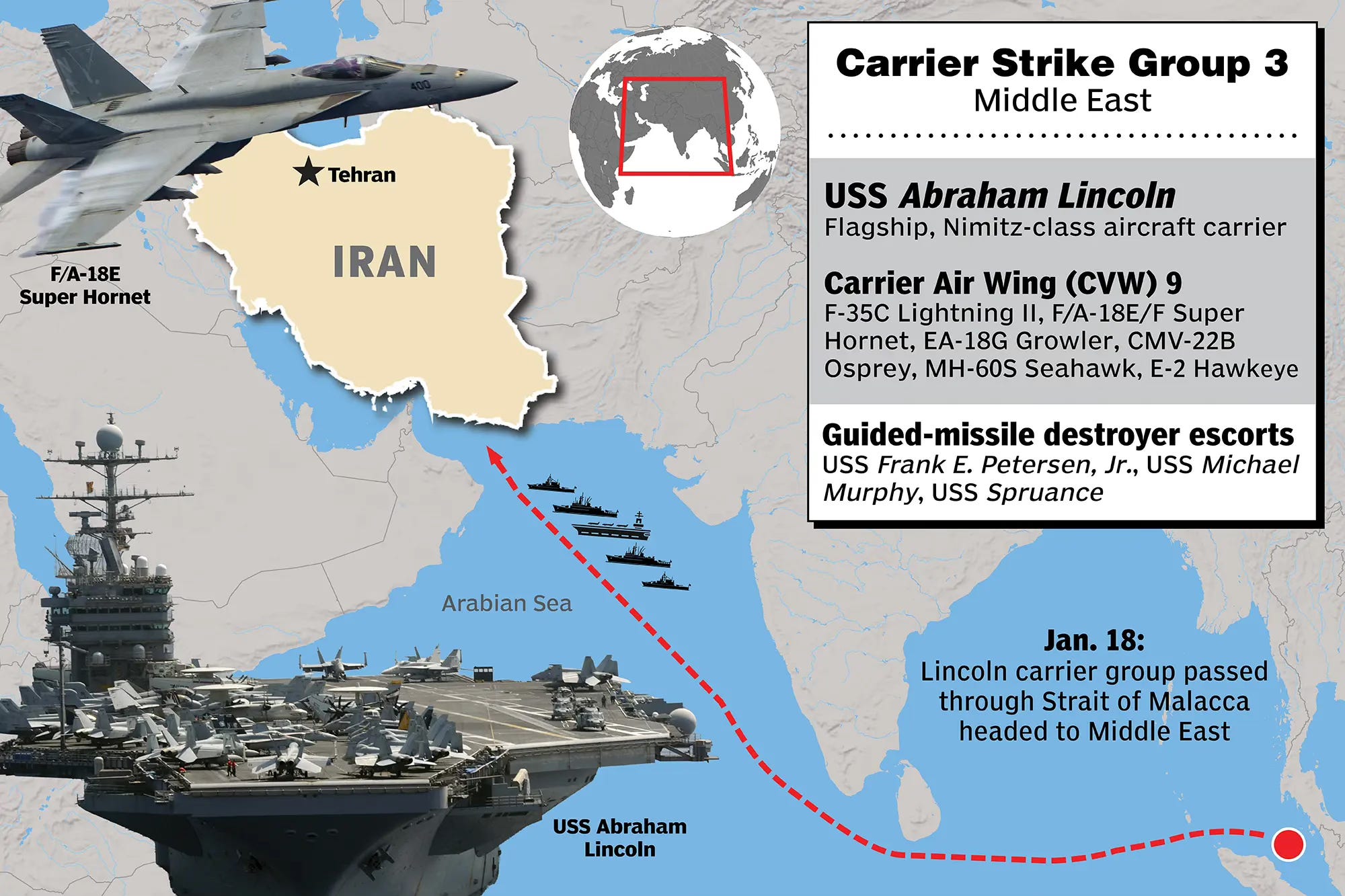
Reuters reports that substantial U.S. military assets are indeed moving toward the Middle East, including a carrier strike group centered on the USS Abraham Lincoln, with additional air defense systems under consideration. Reuters notes the buildup resembles the summer 2025, when the United States struck Iranian nuclear facilities. Reuters also reports that the International Atomic Energy Agency has not verified Iran’s enriched uranium stockpile for more than seven months.
“This cannot go on forever…” the U.N.’s top nuclear watchdog Rafael Grossi said on Tuesday.
That verification gap is not an academic problem. It is a strategic accelerant toward military action.
The United Kingdom, meanwhile, has publicly announced Typhoon deployments to Qatar under the U.K.-Qatar Defence Assurance Agreement. The press language is careful and defensive. The operational effect is obvious to anyone who has ever built a theater for conflict: it strengthens the air defense umbrella around critical basing and helps distribute the burden of keeping Gulf skies stable if the region transitions from warnings to weapons.
Defense analysts watching open sources, including The War Zone, describe a broader pattern of buildup and posture adjustment, with an emphasis on readiness and optionality rather than a single narrow mission set.
This is not just signaling. This is positioning. In coercive diplomacy, there is a difference.

Madman theory
There is an old deterrence concept associated with Richard Nixon, often called the “madman theory.” It is not truly madness, it is a manufactured image of unpredictability. The leader wants the adversary to believe he might do something outside conventional restraint, something too costly or too escalatory, if pushed. The goal is not war for its own sake. The goal is to extract concessions without having to fight.
During the Vietnam War, Nixon aides let it slip to Hanoi that the president was so obsessed with communism that he might resort to a nuclear strike if they didn’t come to the peace table. He also used it against the Soviets.
The theory only works when the threat is credible and when the adversary believes the leader is willing to accept political and reputational risk.
This is where President Trump’s public style matters strategically. He repeatedly collapses the distance between private intent and public messaging. He does it with targets, timelines, and posture. You can dislike the style and still recognize the function. It hardens perceived resolve and it injects uncertainty into Tehran’s calculations. It also compresses decision time, cornering both sides by raising public stakes.
In short, it increases coercive leverage while raising escalation risk.
Coercion Cycles
We have been at the brink with Iran before, but two structural changes stand out.
First, the post-June 2025 reality. Open reporting indicates that the strikes that summer degraded Iran’s declared nuclear infrastructure. Yet the IAEA verification gap today means that the most important questions are unresolved: Where is Tehran’s highly enriched material? What survived the strikes? And how quickly can Tehran reconstitute what was damaged?
When an adversary’s most consequential capability becomes uncertain, worst-case assumptions become more attractive. That is how wars become rationalized.
Second, the communications posture. Strategic ambiguity is a tool. When leaders abandon it, they may gain coercive strength, but they also narrow off-ramps. A leader who says the secret thing out loud is telling the adversary, and the world, that the window is not open indefinitely.
That changes the bargaining environment.
Will Iran blink first, and will blinking even matter?
It is easy to ask whether Iran will blink. It is harder to ask whether blinking would matter if Washington and Jerusalem believe their clock is still running.
Iran’s leadership has three broad options.
Blink and concede. That risks the regime’s internal legitimacy, a global level humiliation, and a fracture of Tehran’s elites. And If its concessions are verifiable and immediate, they can stop Trump’s momentum. If they are not verifiable, they may not be believed.
The regime cannot blink. But preserving their ideological posture invites further strikes.
Should it retaliate early or preempt? That can impose costs and possibly slow or deter follow-on action, but it risks crossing thresholds that trigger a broader campaign of its enemies against it.
The most dangerous dynamic is this: If U.S. and Israeli decisionmakers conclude that the regime’s nuclear reconstitution is proceeding amid the absence of IAEA inspections and verification, then even a partial Iranian blink could be interpreted as tactical delay, not a strategic stand down. In that environment, coercion evolves into a corridor for kinetic action.
Warning Indicators that Matter
Open source communities and reliable defense reporting can miss as much as they reveal. Still, there are publicly available indicators that historically correlate with a transition from coercion to strike.
Watch for formal evacuation directives and a broad departure of non-essential personnel across multiple Gulf states. Watch for a surge in aerial refueling and persistent ISR (intelligence, surveillance and reconnaissance) patterns beyond routine reassurance. Watch for maritime warnings, airspace closures, and shipping advisories that reflect real expectations of kinetic activity. Watch for shifts in Israeli civil defense posture from readiness to explicit war directive changes. Watch for a sudden discipline in Washington’s public messaging, which can signal that decisions have moved from politics to execution.
No single indicator is decisive. A cluster is.
The law of Unintended Consequences
A war with Iran is easy to start and hard to stop. That is not a cliché. It is the operational reality of a theater saturated with proxies, missiles, drones, shipping chokepoints and cyber options.
Even a limited U.S. strike package can produce escalation traps: Iranian retaliation against regional U.S. or allied bases, shipping, or partners. A second round of strikes to restore deterrence. A third round driven by Iran’s roiling domestic politics. And suddenly the original objective is forgotten as the conflict becomes self-sustaining.
Once unleashed, the conflict trajectory is shaped less by speeches and more by retaliation management, escalation control, and the ability to define an achievable end-state.
So is what we’re seeing now another round of coercion before hell breaks loose? Yes, it is coercion. But it is coercion with teeth, and with a credible pathway to war already paved.
The only way this might end without strikes is for Iran to produce a concession package that is fast, verifiable, and politically survivable for the regime. It will have to address the IAEA continuity gap, the stockpile uncertainty, and the perception that Tehran is running a nuclear sprint under the cover of diplomatic fog.
If Tehran cannot or will not do that, blinking may not matter. The strategic clock, as Washington and Jerusalem perceive it, may still be running. And in that case, the decision point is not distant. It is near.
In the coming days, the public will see more ships, more aircraft, more warnings, and more analysis. But the core issue is simpler than the noise.
Coercion is a chess move. War is what happens when the players decide there is no longer any benefit to waiting.
We are watching the board being set. ###
References
Reuters, “US military assets heading to Middle East even as Trump backs off toughest Iran rhetoric,” January 22, 2026.
Reuters, “Explainer: What is the status of Iran’s main nuclear facilities?” January 16, 2026.
Reuters, “Checking Iran’s enriched uranium stock is ‘long overdue’, IAEA report says,” November 12, 2025.
UK Government (gov.uk), “UK Joint Squadron deploys Typhoon jets to Qatar,” January 22, 2026.
The War Zone, “Military Buildup In The Middle East Continues, Including What Trump Describes As A ‘Big Flotilla’,” January 22, 2026.
PBS NewsHour, “UN watchdog hasn’t been able to verify Iran’s stockpile of near weapons-grade uranium in months,” November 12, 2025.
Ken Robinson is a former U.S. Army Ranger and Special Forces officer with deep experience in intelligence, irregular warfare, crisis operations and Track II diplomacy. He is also founder and director of a global peace and stability initiative, based in Vienna.


Matches other Intel reports. Thank you for sharing.
When the USA used special operations in Guatemala it had some success that led it to try the same tactics in Cuba and other places and they failed. Now Trump, who seems to not really know military operations, may let his success in Venezuela lead to a serious blunder with Iran. I do hope he really chickens out.