

New Year, New Intrigue
The secret services of Israel, Turkey, China, the U.S. and UAE vie for influence in Somaliland

Since October 7, 2023, a rivalry has been unfolding between Israel and Turkey that evokes the “Great Game,” the 19th-century struggle between Czarist Russia and Britain for control and influence in Afghanistan, Iran, and Central Asia. Then, as now, this rivalry involves espionage and intelligence gathering, diplomatic intrigue, proxy warfare, and military missions. The U.S. is on the verge of getting more involved.
Israel and Turkey are competing for influence in Gaza, Syria, and now also in the Horn of Africa. The latest expression of this contest is the decision by Israel’s government, led by Benjamin Netanyahu, to recognize Somaliland as an independent and sovereign state and to establish open relations with it, including the opening of diplomatic missions in Hargeisa and Tel Aviv.
President Recep Tayyip Erdoğan has for years pursued regional hegemony and sought to revive the glory days of the Ottoman Empire; Prime Minister Netanyahu is attempting to challenge him. Donald Trump, who claims friendship with both leaders, has to maneuver carefully between them.
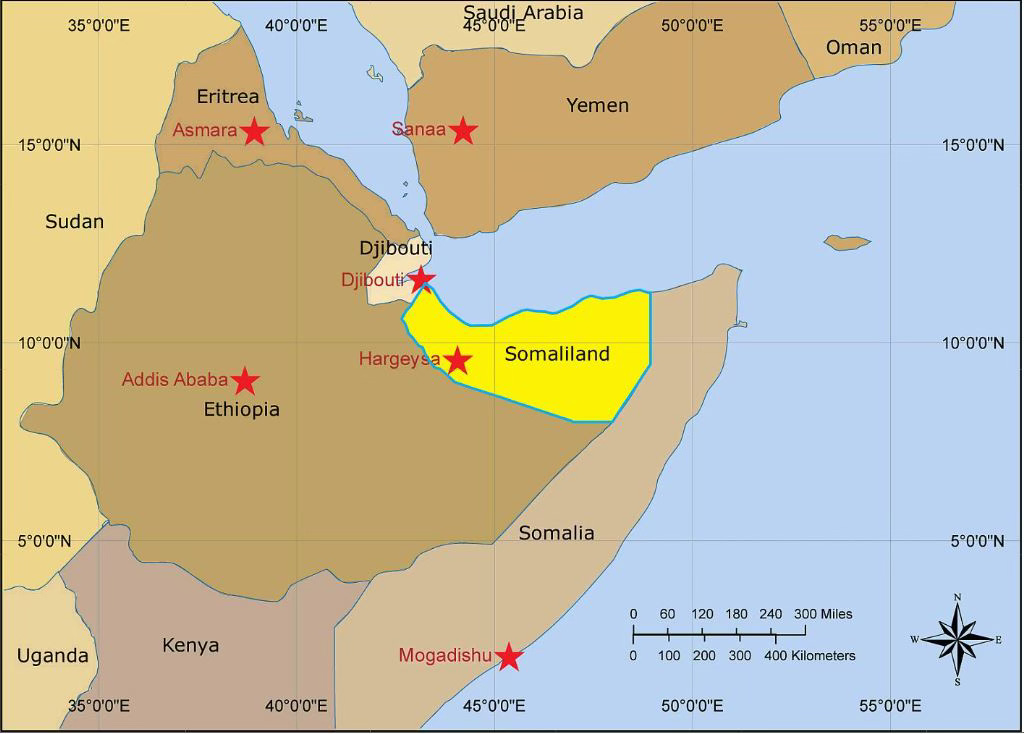
Israel is the only U.N. member state to recognize Somaliland (distinct from Somalia to its east) as an independent country. Taiwan (officially the Republic of China) also recognizes it, but Taiwan itself is not a U.N. member and is itself recognized as a sovereign state by only 12 countries.
Both Somaliland and Somalia are a clear product of Western imperialism in the 19th century. Three European powers—France, Italy, and Britain—conquered the region and divided it among themselves. In 1960, Somalia was established, with Mogadishu as its capital, after gaining independence from British and Italian rule. French Somaliland also gained independence and in 1977 became Djibouti. All three of these states are Sunni Muslim. Alongside them, in the Horn of Africa, lie Ethiopia, which is majority Christian and Eritrea, split about evenly between Christian and Muslim. .
In 1991, the regime of Somali dictator Mohamed Siad Barre, who was supported by the U.S., collapsed, and the country descended into civil war, without an effective central government for many years.
Against this backdrop, the territory that had been part of Britain broke away and declared itself an independent state called Somaliland. With some five million inhabitants, a long coastline along the Gulf of Aden and the Red Sea opposite Yemen. its strategic importance is evident in the fact that 12% of world commerce passes through its nearby waters.
At the same time, parts of Somalia, including the capital Mogadishu, were taken over by the Islamist terrorist organization al-Shabaab, which became a regional affiliate of al-Qaeda. Al-Shabaab and al-Qaeda operatives became a destabilizing force across the region and carried out numerous deadly attacks in Somalia.
These attacks spread to neighboring countries as well. In 1998, terrorists bombed the U.S. embassies in Nairobi, Kenya, and Dar es Salaam, Tanzania, killing hundreds of people.
Israel, too, was in their sights. On November 28, 2002, two attacks were carried out in the port city of Mombasa, Kenya, killing three Israelis and twelve Kenyans.
The Mossad, under Meir Dagan, in cooperation with the CIA and Kenyan intelligence—which has worked with Israel for decades—launched a manhunt for the terrorists. After several years, the CIA settled accounts with the terror network and eliminated its operatives.
Almost since its founding, Israel has viewed the Horn of Africa as a region of strategic importance, due to its proximity to its Arab enemies—Yemen and Saudi Arabia along the Red Sea, and Sudan and Egypt on the African continent. Israeli interest in the region was also driven by the Gulf of Aden and the Bab al-Mandeb Strait—the maritime routes leading to Eilat, Israel’s southern seaport.
Mossad Moves In
Accordingly, already in the early 1960s, the Mossad established a station in Ethiopia, then ruled by Emperor Haile Selassie. The Mossad station there served as a springboard for inserting agents into Arab countries in the region. Unit 8200 of Military Intelligence, Israel’s version of America’s eavesdropping and code-breaking National Security Agency, set up a listening post in Ethiopia. In return, Israel sold arms to Ethiopia, IDF troops trained the emperor’s army and his personal guard.
After Ethiopia’s monarchy was overthrown in a military coup in 1974, the new ruler, Colonel Mengistu Haile Mariam, established a pro-Soviet socialist dictatorship and severed ties with Israel. It was a severe blow to Israel’s geopolitical strategy.
The decision to establish open relations with Somaliland is an effort to bring back Israeli military and intelligence presence in the Horn of Africa.
Jerusalem considers it even more vital because of the war in Gaza. In solidarity with Hamas, the pro-Iranian Houthi regime of Yemen fired missiles and drones against Israeli cities, as well as targeted ships carrying cargo to Eilat, heightening the importance of Somaliland, which lies at the southern entrance to the Gulf of Aden and the Bab al-Mandeb Strait.
Alongside Israel’s military presence in Syria—which is gradually coming under Turkey’s sphere of influence—Prime Minister Netanyahu’s new move is also intended to block Erdoğan’s moves in the Horn of Africa.
At a festive ceremony held a year ago in Ankara, Turkey’s military pension fund (OYAK) and the Somali government signed a far-reaching agreement. Under the deal, OYAK will become a partner in the Somali-Turkish fishing company SOMTURK, hold exclusive rights to the country’s rich fishing resources, and be responsible for management, operations, and licensing in the sector.
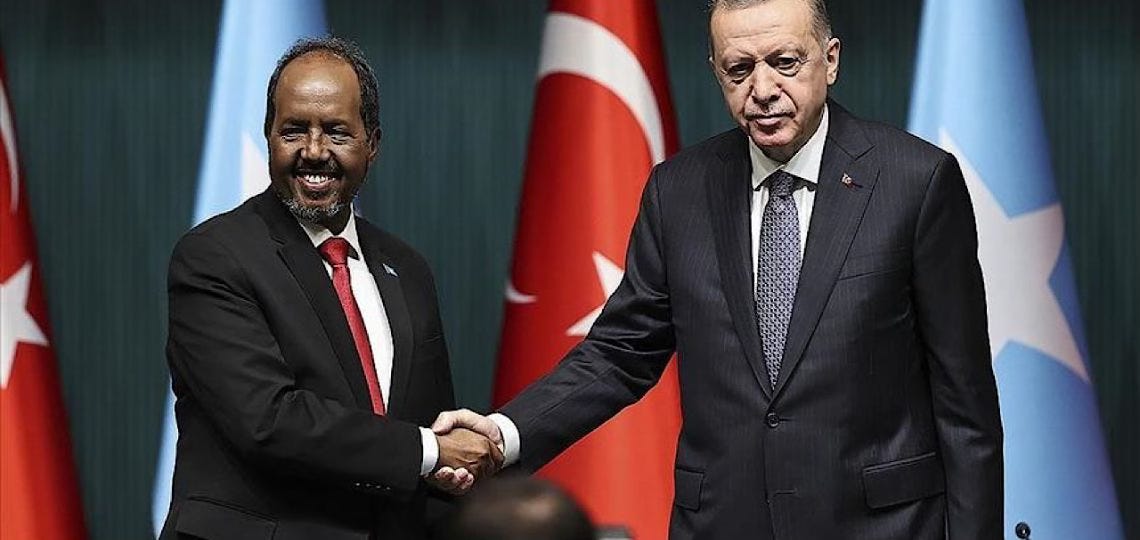
Turkey’s Defense Minister Yaşar Güler and Chief of Staff General Selçuk Bayraktaroğlu attended the signing ceremony. What do Turkey’s defense minister and chief of staff have to do with tuna and sardines swimming off Somalia’s shores? Not much—yet their presence says a great deal about Turkey’s deep ties with Somalia and its real intentions.
Power Moves
Turkey has put down deep roots in the country—not only at sea, but also on land and even in the air. Turkey’s largest military base outside its own territory, as well as its largest embassy, are located in Somalia. Since 2017, Turkey has trained some 15,000 Somali soldiers at the Turk-Som base; Somali officers have undergone advanced courses in Turkey; thousands of Somali students have studied in Turkish-built schools; Turkish companies operate Mogadishu’s port and international airport; and recently Turkey established a base on Somali soil to test its Typhoon-type ballistic missiles with plans also to operate a space-launch testing facility there.
Thus, Somalia has effectively become a Turkish client state. Ankara leverages its investments and military assistance for political ends, using Somalia as a bridgehead to other African countries.
It is therefore no surprise that Erdoğan condemned Israel’s decision to recognize Somaliland. All Arab states condemned the move as well—except one: the United Arab Emirates, which is involved in the war against the Houthis. The UAE does not recognize Somaliland, but it has invested about $440 million in developing the port of Berbera through its giant conglomerate DP World and has established a military base there. From Abu Dhabi’s perspective, Somaliland is a vital strategic hub, whose importance grew after its failure to secure management rights at the port of Djibouti.
The Emirates are also promoting the re-partition of Yemen into two states—north and south. Such a move would also serve Israeli interests.
The UAE maintains strong security and intelligence ties with Israel. Only recently, Israel’s Elbit Systems concluded the largest deal in its history—$2.3 billion—for the sale of defense systems, know-how, equipment, and technologies to be installed on the UAE’s air force and civilian aircraft.
It would not be surprising if proof surfaced that, with Emirati assistance, Israeli Navy ships and submarines are calling at the port of Berbera in Somaliland, shortening distances to Yemen and Iran. In such a scenario, the Israeli Air Force could also benefit from proximity to Yemen and gain an additional aerial route to Iran— especially since Netanyahu is once again threatening to attack Iran and is seeking the support of Trump for such a repeat move.
Israel’s military partnership within the strategic framework the UAE is building around Yemen and the Horn of Africa could put it on a collision course with Turkey.
Israel also hopes that Washington will follow its lead and recognize Somaliland. So far, however, Trump has displayed only coolness and disdain for the region. “Does anyone even know what Somaliland is?” he remarked in response to Netanyahu’s decision. Yet his dismissal rings hollow. Back in May the president of Somaliland reported visits by senior U.S. military delegations to his country, in addition to the covert ties maintained by the CIA with Somaliland. The Trump-allied “Project 2025” also advocated recognizing Somaliland statehood as a strategic move to counter growing Chinese influence in the Horn of Africa, particularly its military base in Djibouti.
The Great Game is indeed back. Only the players have changed.
Thank you
Hi Yossi, great rundown. Would you have any further sources you'd recommend for someone interested in Mossad's activities in Africa and the ongoing battle for influence in the Horn?