


There are few more enthusiastic evangelists for the promise of AI than Kai-Fu Lee. Suave and charming, with a taste for fine wine (and a Ph.D from Carnegie Mellon), Lee founded the Beijing-based Sinovation Ventures, a venture capital giant that is helping to finance some of China’s most innovative tech firms on everything from robotics to advanced facial recognition. But when I recently heard him describe his latest crusade—to incorporate a concept he calls “Boss AI” into the management of large enterprises—he threw me for a loop.
The idea of Boss AI — the subject of the latest book by Lee, a prolific author— is that the superpower of artificial intelligence can be used as a “decision brain” to advise CEOs and “identify anomalies” in their companies. How? By taping every meeting and scouring every email, Boss AI will instantly identify malcontents, under-performers or members of the workforce otherwise less than enthusiastic about the corporate mission. This, he argues, is the key to unlocking profitability and ultimate success in China’s relentless race to dominate the future of technology and perhaps the world.
But as I listened to his pitch as part of a group he had invited to China to tour some of the companies he’s invested in and meet with him at his Beijing conference room, all I could think of was 1984.
“I have to say, listening to this,” I told him, “it has a creepy Orwellian vibe.”
“Welcome to China,” he responded with a smile, as if I had revealed my naiveté by even raising such a subject in a country where surveillance cameras are everywhere.
This is another SpyTalk post without a paywall a few paragraphs in. It’s kind of an experiment: We’ll do more of these if readers will continue to sponsor us with paid subscriptions. We can’t do our wide-ranging reporting without you. And we certainly appreciate your generosity. Thanks.
The members of my group witnessing this exchange were mostly venture capitalists but also a smattering of others, including a former senior U.S. national security official and a journalist (me.) Some also happened to be company managers in their own right, and pushed back on my critique. Don’t firms in the U.S. already own their employees’ emails? Don’t they have an interest in knowing who is not performing up to snuff? What’s the big deal?
Sure, I replied, but it is advances in technology that make all the difference. To pick a relevant analogy, authoritarian governments have always had an interest in crushing political dissent. But in Orwell’s classic, it was the omnipresent telescreen — the two-way video watching your every move in every room—that turned Oceana into a totalitarian dystopia.
Is Boss AI the new Big Brother?
And what happens when, as is inevitable, it migrates to corporate America and beyond — to universities, for example, in order to police academic content in classrooms (a version of which is already taking place in Texas) or, it’s not hard to imagine, a Trump administration ever eager to enhance surveillance of targeted groups or crackdown on government employees who, among other misdeeds, might dare to talk to journalists? Or how about a DOGE 2.0 powered by Boss AI?
Second Thoughts
In any case, it was my exchange with Lee that encapsulates my complicated reaction to a week-long visit to the Heavenly Kingdom —and what it might mean for U.S.-Chinese competition in tech, trade, military hardware and intelligence.
On the one hand, Xi Jinping’s China, for all its recent problems with wage stagnation and youthful unemployment, remains an economic powerhouse. In our travels to Beijing, Hangzhou and Shanghai, we saw glittering skyscrapers for as long as the eye can see, luxury shopping malls and a robust private sector giving Silicon Valley a run for its money. Our group toured an EV auto factory where 90 percent of the workforce are humanoid robots. We visited a cutting edge research firm where they’re inserting chips into brains to cure patients with spinal cord injuries and other maladies (leaving open the question of what else those chips might ultimately be used for).
We stopped in at luxury malls where wealthy Chinese consumers can buy Louis XIII cognac (for the equivalent of $3,899 a bottle) or Christian Dior handbags. Also ubiquitous were the Huawei stores where the displays and products seemed virtually identical to what you can see at your nearest Apple outlet.
It took a political analyst for a Chinese consulting firm whom we lunched with to remind us that next month Huawei goes on trial in federal court in Brooklyn, N.Y. charged with a years long racketeering conspiracy to steal U.S. trade secrets and skirt U.S. sanctions on Iran by using a Hong Kong-based shell company to sell it equipment used for domestic surveillance of political protestors.
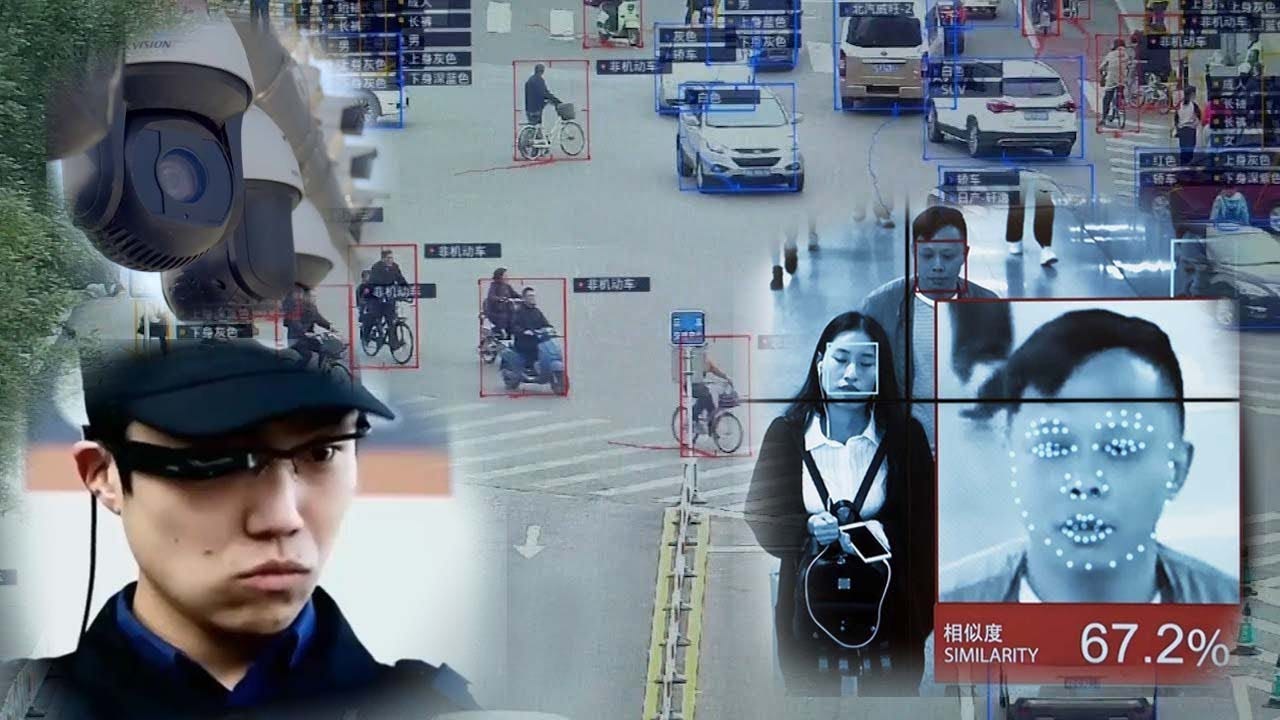
That was hardly the only reminder of the dark side of China’s economic progress. Plenty visible were the ubiquitous surveillance cameras catching every public interaction on video, a modern day, real life version of Big Brother’s telescreen. The guide who took me to the Great Wall on his own started pointing them out on every block and street corner. Ostensibly, they are there for crime control and public safety. But unmistakable is the intimidation factor. Unseen was the government’s security software tracking individual’s purchases, financial history and media use, which monitors what people watch, read, post, and share online. The Chinese know they are being watched.
Over lunch, the political analyst talked about a younger generation of Chinese Communist leaders taking the reins in the country’s provinces. So who, I asked, is in line to replace Xi? Not an issue, nobody’s thinking about that, the analyst maintained. The 73 year old Xi, who took power 16 years ago, is planning to extend his term once again later this year, keeping him on track to rule China into the 2030’s. (The last time Xi extended his term, in 2023, the National People’s Congress—all of whose members are appointed by the Communist Party—ratified the move by a vote of 2,952 to 0.)
Pest that I am, I asked about the prospects of political reform—some loosening of the party’s grip that might allow a few small democratic freedoms? The reply was even more brusque: Not in the cards, the analyst said simply and left it at that. (As if to underscore the point, a few days after I left China, two pro-democracy activists in Hong Kong– who led annual candlelight vigils to commemorate the 1989 crackdown in Tiananmen Square– were convicted of subversion under a national security law. They face up to 10 years in prison) .
Excluded
Perhaps the strongest sign of the all-encompassing intimidation factor that prevails in Chinese society came just before our group was scheduled to have lunch with Kuo Zhang, the president of Alibaba.com, the booming e-commerce division of China’s most iconic company, the Alibaba Group (with annual revenue of $148 billion.) I was politely informed that I and the former U.S. government official in our group, Jon Finer, who served as deputy national security advisor in President Biden’s White House, were banned from the meeting, no doubt for “different reasons,” as Finer put it. In Finer’s case, it might have been for, among other things, the 2022 remark by his boss, President Biden, that the U.S. would defend Taiwan in the event of an attack by China, a comment that in one breath seemed to toss away the U.S. government’s half-century long “strategic ambiguity” understanding with Beijing on that question and was immediately condemned by the Chinese government. In my case, being identified as a contributing editor of a journal called SpyTalk no doubt got their attention as well.
(A more intriguing exclusion targeted the third member of our group, a rather striking and personable Russian yoga instructor who holds yoga retreats all over the world, dividing her time between Moscow, Bali and Switzerland. No explanation was given for keeping her out of the lunch, but Finer and I didn’t hesitate to speculate.
But the more interesting question is why the blacklist in the first place. As we later confirmed with our colleagues, Alibaba’s Zhang, one of China’s most high ranking business executives, had nothing remotely sensitive to say in his luncheon talk. But even such a prominent figure as he was no doubt aware about what a Party minder might report on him consorting with— or simply granting an audience to — suspicious characters like Finer and myself.
And he certainly wouldn’t want to have to answer to Boss AI.
None of Michael Isikoff’s expenses for his trip to China were compensated by any Chinese companies or the Chinese government. He paid for the trip himself.
Just...WOW! Great and important story and oh so frightening. Thanks Mike and Jeff. But...damn.