

JFK’s Fatal Mistake
A veteran journalist takes another look at President Kennedy’s ambivalent role in the overthrow and assassination of South Vietnamese President Ngo Dinh Diem

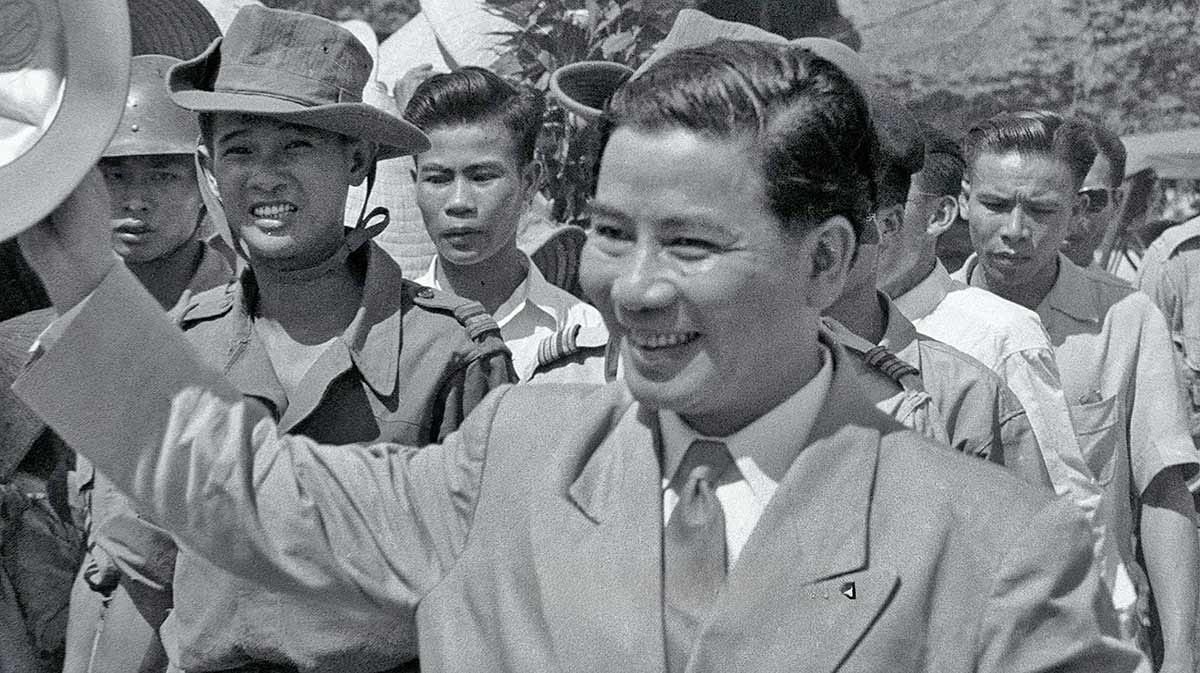
John F. Kennedy is today rightly remembered for his firm and steady resolve that averted nuclear catastrophe during the 1962 Cuban missile crisis. But nine months later, Kennedy was torn with indecision as he faced another, very different foreign policy crisis.
In the summer of 1963, Kennedy was at a loss about what to do about the increasingly repressive behavior of South Vietnam’s president, Ngo Dinh Diem. A cabal of State Department officials was pushing for a U.S.-backed military coup and got the president, who was on a weekend getaway with his family in Hyannis Port, to hastily sign off on a cable essentially green lighting one.
But Kennedy was filled with doubts. Barely five days later, he dispatched a follow-up cable whose wording should ring through the ages.
“Until the very moment of the go signal for the operation by the Generals, I must reserve a contingent right to change course and reverse previous instructions,” JFK wrote to his new ambassador in Saigon, Henry Cabot Lodge, Jr. “I know from experience that failure is more destructive than an appearance of indecision…If our national interest should require a change of mind, we must not be afraid of it.”
Admitting a foreign policy misstep and reversing course is rare indeed in presidential history (and anybody cognizant of the failures of Middle East policies over the past 25 years might wish it was done more often). But as veteran journalist Jack Cheevers shows in his gripping new book, Kennedy’s Coup: A White House Plot, a Saigon Murder, and America’s Descent into Vietnam, the young president’s tentative, “contingent” reversal of course was—at best—a half-step followed by more back and forth shuffling that left U.S. policy a muddle. Lacking any clear direction from Washington, Lodge—an imperious Boston Brahman whom JFK had defeated in his 1952 Senate race—worked with a free wheeling CIA agent to encourage (and fund) a gaggle of disaffected South Vietnamese generals to move forward with their scheming to overthrow the government of this U.S.-backed ally.
“While the generals revved up their plotting in October [1963], JFK drifted along, buffeted by the pro-and anti-Diem cliques in his administration and unwilling or unable to take a firm position on the coup,” writes Cheevers, offering a conclusion that is sure to rankle the admirers of Camelot. “By his indecisiveness, Kennedy relinquished whatever leverage the United States might have had” to influence events on the ground. (You can listen to Cheevers talk about his book starting Friday on the SpyTalk podcast.)
The result, as is well known, was an unmitigated disaster. The generals, led by Duong Van Minh, a French-educated hulk of a man known as “Big Minh,” who proudly displayed his two busted front teeth as a symbol of his toughness and held a grudge against Diem for being sidelined from his command, had little popular support, much less governing experience. Under Minh’s orders, Diem and Ngo Dinh Nhu, his much feared brother who served as chief of the secret police, were loaded into an armored personnel carrier, their hands tied behind their backs. The South Vietnamese president was shot in the back of the head; his brother butchered with a bayonet. Kennedy, who wanted them flown safely into exile if the coup went forward, was horrified. The U.S. government had blood on its hands.
The Vietnam coup was the original real-life version of the dictum that Colin Powell, then a young U.S. Army captain serving as a U.S. “advisor” in South Vietnam, would issue four decades later on the eve of another misguided war: his so-called “Pottery Barn rule” for foreign interventions: “If you break it, you own it.”
The U.S. had been party to an insurrection, leaving the country all but rudderless in the midst of its battle against the North Vietnamese-backed Viet Cong. It now owned the outcome. America’s long “descent” into a full-scale land war in Southeast Asia—something Kennedy had been warned against and never wanted—had begun.
Cheevers’ massive book, weighing in at 671 pages and based on years of prodigious research into a mountain of declassified files and personal papers, has clear lessons for today, starting with the most obvious one: Getting rid of the top guy doesn’t solve your problem, as America learned the hard way in Iraq and again most recently, in Iran. It is especially the case when there is no clear strategy for what comes next.
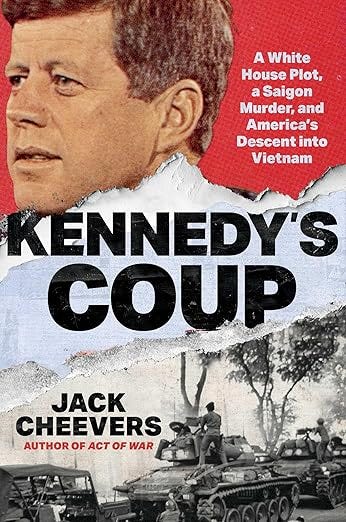
THAT WAS NO SECRET to many of those inside Kennedy’s administration who were adamantly opposed to the coup idea all along. Among them was William Colby, formerly the CIA station chief in Saigon, who by 1963 had been elevated to chief of the agency’s Far East Division. Like the rest of the CIA brass, Colby had been cut out of the weekend discussions when Kennedy signed off on the original “green light” coup memo. When Colby saw it, he immediately pinpointed the problem, recognizing that none of the generals plotting to depose Diem inspired any confidence—in Washington or even among themselves. The coup plan “appears to be throwing away bird in hand before we have adequately identified birds in bush, or songs they may sing,” Colby wrote in a prescient memo to his successor as station chief, John Richardson. Colby would later call the coup “the worst mistake of the Vietnam War.”
The story Cheever tells is a sprawling one, with Shakespearean overtones. If JFK’s doubts, his betwixt and between hemming and hawing, evokes Hamlet, the secret plots, conspiracies, betrayals, (and subsequent regrets) from Washington to Saigon, are straight out of Julius Caesar. At its center is Diem, a devout Catholic and fervent anti-Communist, who just a few years earlier was being hailed in Washington as the savior of his country. Life Magazine had proclaimed him “The Tough Miracle Man of Vietnam.” When he flew to the U.S. in 1957, President Dwight D. Eisenhower personally greeted him at the airport. In Washington, he addressed a joint session of Congress. In New York, he got a ticker tape parade.
Cheever’s book has clear lessons for today, starting with the most obvious one: Getting rid of the top guy doesn’t solve your problem.
But by the early 1960s, doubts about Diem were growing. He was aloof, stubborn and often refused to take advice from visiting U.S. officials, lecturing them for hours on end about how they didn’t understand his country. More disturbing, despite the trappings of democracy, he had little respect for democratic norms. When Buddhists took to the streets to protest what they perceived as discriminatory treatment, Diem and his hardline brother’s instincts were to crack down and round up the demonstrators, throwing them into prison and torturing them. In time, Buddhist monks began burning themselves in spectacular fashion, captured on camera by U.S. newsmen and shocking the American public.
Cheevers argues, somewhat controversially, that at least some of the criticism of Diem was overblown, contending that there was no systematic persecution of the Buddhists and that some of the monks were savvy agitators. Notably, Frederick Nolting, Kennedy’s first ambassador to Saigon, shared that view and defended him to the end.
But the case for Diem wasn’t helped by the headline-grabbing antics of Nhu’s wife, aka Madame Nhu, otherwise known as the Dragon Lady. With her tight dresses, heavy makeup and bouffant hairdo, Nhu lashed out at the Buddhists as a bunch of “crooks” and “Communists” and offered to supply the gasoline for the next monk who wanted to “barbecue” himself.
Even more damaging for the image of the regime, aggressive reporters on the ground—most notably David Halberstam of the New York Times and Neil Sheehan of UPI—wrote relentlessly about Diem’s abuses while challenging, much to Kennedy’s irritation, claims by the U.S. military and the Diem regime they were winning the war against the Viet Cong.
These days, the very mention of a U.S.-sponsored coup is likely to conjure memories of what the CIA did during the 1950s, when the agency’s covert operatives overthrew leftwing governments in Iran and Guatemala, replacing them with dictatorships. It is, therefore, a bit jarring to read, as Cheevers lays it out, that it was actually liberals at the State Department who pushed upon Kennedy the idea that Diem should be disposed of and replaced with the generals.
At the time, there was little, if any, dissent within fashionable foreign policy circles against the Cold War consensus that the U.S. could not allow South Vietnam to fall to the Communists. The question was how best to ensure that didn’t happen, and the progressive-minded coup plotters argued that sticking with an authoritarian like Diem was counterproductive, that it undercut the U.S. case that it was backing a war for freedom and democracy in Southeast Asia.
Still, it is a startling to learn that, of all people, it was John Kenneth Galbraith—the Harvard economics professor then serving as U.S. ambassador to India, and one of the leading liberal intellectuals of the day—who first suggested to Kennedy in late 1961 that he should ditch Diem, even if it resulted in a military coup, on the grounds that it was the only way to ensure that the “bright promise” of the New Frontier didn’t get “sunk under the rice fields.”
A year and a half later, it was a mid-level official in the State Department, Roger Hilsman, who took up the cause. A former U.S. Army officer with a PhD in international relations from Yale, Hilsman had been tapped by Kennedy to head the State Department’s intelligence bureau—where he forcefully began pressing the idea that Diem had to go. Kennedy, fed up with the lousy press he was getting over his Vietnam policy, was clearly receptive. “The time may come when we’re gonna have to do something about Diem,” he told Lodge in an Oval Office meeting on August 15, 1963. “I think we have to leave it almost completely in your hands and your judgment.”
(Kennedy had several acerbic comments about others during this conversation, taped via a secret Oval Office system he could activate with a button on his desk. He groused about Halberstam’s stories in the Times and “this bitch,” Madame Nhu. “Is she a lesbian or what?” he asked Lodge. The new ambassador averred she probably was.)
There is a line of thinking that Kennedy only brought in Lodge— an old political rival who had been Richard Nixon’s running mate in 1960 and even then was being mentioned as a possible 1964 GOP presidential candidate—to give bipartisan cover to whatever failures in Vietnam lurked around the corner.
But none of that mattered to Hilsman over in Foggy Bottom. On a Saturday in late August, with backing from his boss, Undersecretary of State and veteran diplomat Averell Harriman, as well as National Security Council staffer Michael Forestal, Hilsman drafted what Cheevers calls “one of the most fateful directives of the Vietnam War.” Diem, he wrote, needed to ditch his brother Nhu— something he had consistently refused to do—and if he still balked, he should lose U.S. support. Rather than leaving it to Lodge’s judgment, the ambassador should be instructed to “make detailed plans as to how we might bring about Diem’s replacement if this should become necessary,” and he should tell Diem’s restive generals that Washington would give them “direct support in any interim period of breakdown.”
Rush to Judgment
Hilsman, Harrisman and Forestal—“the Gung-ho boys,” Cheevers calls them—pushed Kennedy to immediately sign off. At the time, other principals were away for the weekend and out of the loop. CIA chief John McCone was yachting in Puget Sound. Defense Secretary Robert McNamara was hiking in the Grant Tetons. Secretary of State Dean Rusk was at a Yankees game in New York. So much for a deliberative, interagency review. Kennedy signed off on Hilsman’s memo and U.S. policy— which for a decade had firmly backed Diem— was instantly turned upside down.
At this point, despite Kennedy’s later reservations, Lodge pushed the coup with gusto. “We are launched on a course from which there is no respectable turning back: the overthrow of the Diem government,” he wrote in a cable from Saigon to the State Department on Aug. 29, three days after the Hilsman-drafted “green light” cable. A savvy bureaucratic player, Lodge demanded the removal of Richardson, the CIA station chief who, along with his boss, McCone, was cool on the coup idea. And he used a more sympathetic, off-the-reservation, pro-coup CIA officer, Lucien Conein, as his conduit to the coup-plotting generals, offering them advice and pressing them for their plans. When the time came for the generals to move, Conein showed up at their command center with a diplomatic pouch stuffed with about $42,000 in cash— a U.S.-funded kitty to bribe lower ranking military officers to join the mutiny.
Even while his CIA man was doing so, Lodge showed up for one last meeting with Diem at the palace. A master of duplicity, Lodge engaged in diplomatic niceties, revealing nothing about the ongoing plot to depose his host. But Diem may have sensed something was afoot.
“Please tell President Kennedy that I am a good and frank ally,” Diem told the ambassador as he was getting up to leave. Lodge replied that he always admired Diem’s courage and had since “formed sentiments of friendship for him.” (Not long after, with Diem and his brother murdered, Lodge hosted leaders of the new military junta for a black tie celebratory dinner complete with cigars, champagne, and toasts.)
Remorse
When Kennedy learned of the gruesome murders of Diem and Nhu, he could barely contain himself. Shown the news during a national security council meeting, Kennedy “leaped to his feet and rushed from the room with a look of shock and dismay on his face which I had never seen before,” later recalled Maxwell Taylor, Kennedy’s favorite general, whom he had named as chairman of the Joint Chiefs. After Kennedy left the room, Cheevers writes, Taylor remarked: “What did he expect?”
Anybody reading Cheevers’ account will no doubt be looking for clues to the perennial question still debated by historians: What would Kennedy have done about Vietnam had he lived? Cheevers quotes from multiple memoirs indicating JFK talked quite a bit about getting out of Vietnam—once he got re-elected in 1964. “In 1965, I’ll become one of the most unpopular presidents in history,” he told his appointments secretary, Kenneth O’Donnell. “I’ll be damned everywhere as a Communist appeaser. But I don’t care.” But as Cheevers so amply documents, Kennedy said many contradictory things on the subject, and when it came to the most momentous decision he had to make involving Vietnam, he had endless trouble making up his mind.
For what it’s worth, Kennedy’s final, public pronouncement on Vietnam, unmentioned in Cheevers’ book, was starkly different from what he told O’Donnell. In a speech he planned to give at a lunch at the Dallas Trade Mart on November 22, 1963, Kennedy was going to portray the war in Vietnam as part of a global clash with international Communism that required unflagging U.S. support. Listing South Vietnam as first among nine foreign countries on the front lines of this war, Kennedy was to say: “Our assistance to these nations can be painful, risky and costly, as is true in Southeast Asia today. But we dare not weary of the task…Reducing our efforts to train, equip and assist their armies can only encourage Communist penetration.”
But of course, Kennedy never got to speak those words. Just 20 days after Diem was assassinated, so too was he, leaving behind a legacy on Vietnam that is checkered at best.
You can hear the SpyTalk podcast free at RedCircle or wherever your favorite listening platform. We’re everywhere podcasts are played.