

Jay Clayton Flunked the Test
High drama ensued when Sen. Jon Ossoff began interrogating the DNI nominee

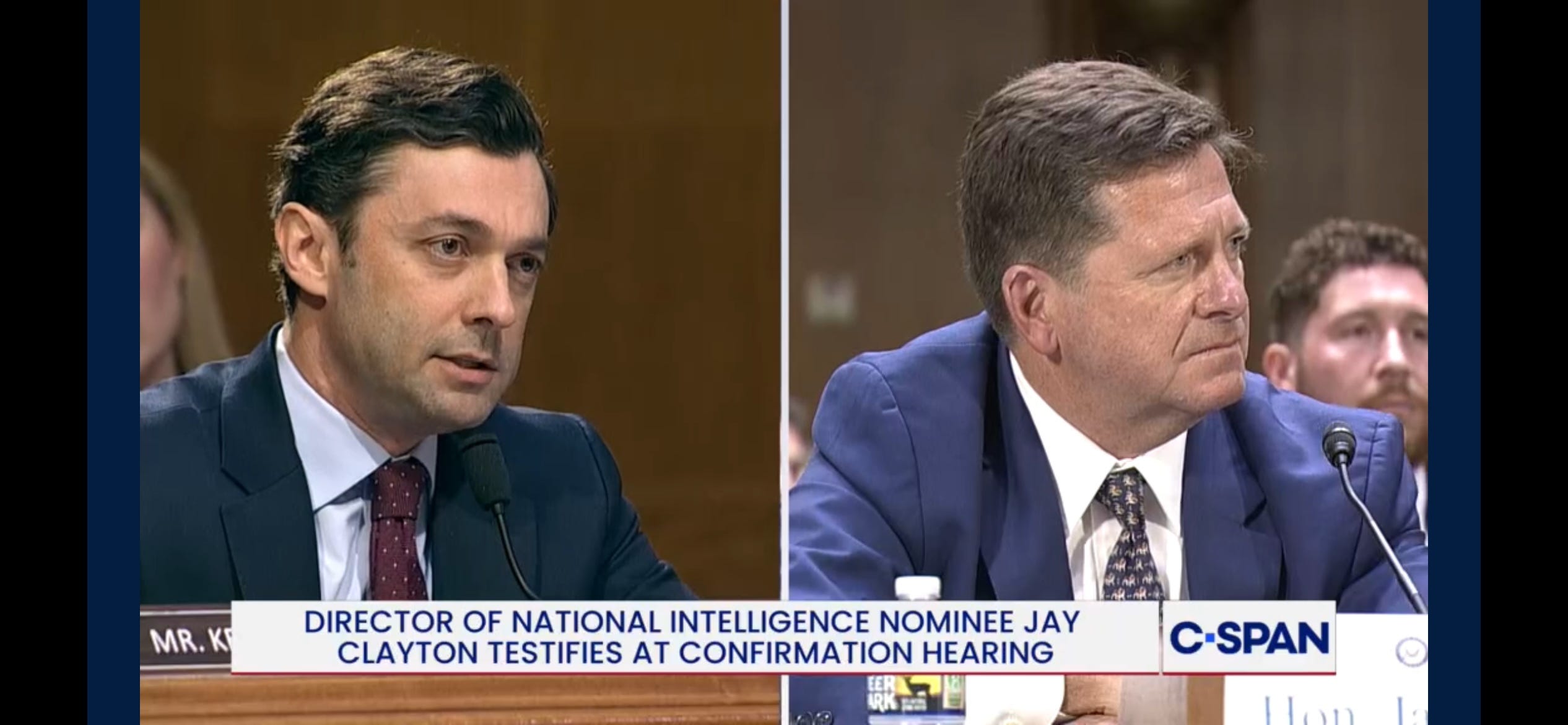
You had to wait for it. It didn’t come until nearly two hours into the all-but-scripted hearing on Jay Clayton’s nomination to be the new boss of U.S. intelligence.
Democrats on the Senate Intelligence Committee did their parts. They threw the expected jabs at Clayton, starting with the ritualized question on who won the 2020 presidential election, a Punch-and-Judy exercise every time a Trump nominee or official appears before them. None of the witnesses can muster the courage to say simply, “Joe Biden won the election.” They know a Trumpian trap door would open under them if they told the truth.
So, too, did Clayton, who entered the high ceilinged, walnut paneled, warmly lit Capitol Hill hearing room with his reputation yet unsoiled, demur. No matter that neither of his previous government stints—as Securities and Exchange commissioner in the first Trump term and U.S. Attorney for the Southern District of New York in this one—remotely qualified him for the job, which by law requires the holder have “extensive national security expertise.” His major qualification for the nomination was fealty to Trump. His major qualification for the job was that he wasn’t the guy there now, MAGA apparatchik Bill Pulte.
But Clayton quickly made clear how far he was prepared to debase himself.
“I’m not an election denier,” Clayton asserted in response to a question from Sen. Mark Warner (D-Va.), the longtime top Democrat on the Senate Intelligence Committee. But then he, like all the other Trump officials summoned to Capitol Hill, fell back on the non-denial denial: “Joe Biden was certified as the president of the United States.” As the minutes ground on, Clayton finally eventually conceded to Warner that Biden was “fairly and duly elected under our process.” That was as far as he was going to go—especially with yet another Trump tirade on elections marketed as an important address to the nation only a day away.
“One of your qualifications is you told us you’re going to tell the truth to power, and you won’t answer a very simple question,” Sen. Angus King (I-Maine) railed. But Clayton was proving to be an unruffled master of deflection, denial and counter-accusations.
For the moment.
Great Expectations
Clayton had every reason to believe his nomination was a cake walk, considering the bipartisan fervor to expel Acting DNI Bill Pulte, who’d taken a chainsaw handed him by President Trump last month to rid the office of any intelligence experts on the world’s hot spots that Tulsi Gabbard had failed to fire. And panel members were in a hurry. Bipartisan advocates of the lapsed electronic counterterrorism surveillance program known as Section 702 knew the law would never be renewed as long as Pulte was in the office. And there was no telling what he was really up to.
Still, there was a stink on Clayton, a growing suspicion he was too much Trump’s man. It turned out he’d personally signed subpoenas demanding grand jury testimony from a team of New York Times reporters who’d revealed the Secret Service’s concern for the security of the Qatari Air Force One that Trump loved so much. According to some reporting, the White House demanded it. Sen. Ron Wyden, D-Ore, called it “a flagrant attack on journalists in the First Amendment under the direction apparently of the Trump administration.” He asked Clayton, “When were you directed to issue subpoenas to the journalists and by whom?”
Clayton dodged and weaved. “I don’t wanna get into this in, in too great a detail because it’s inappropriate,” he said.
Time was up for that. The committee moved on.
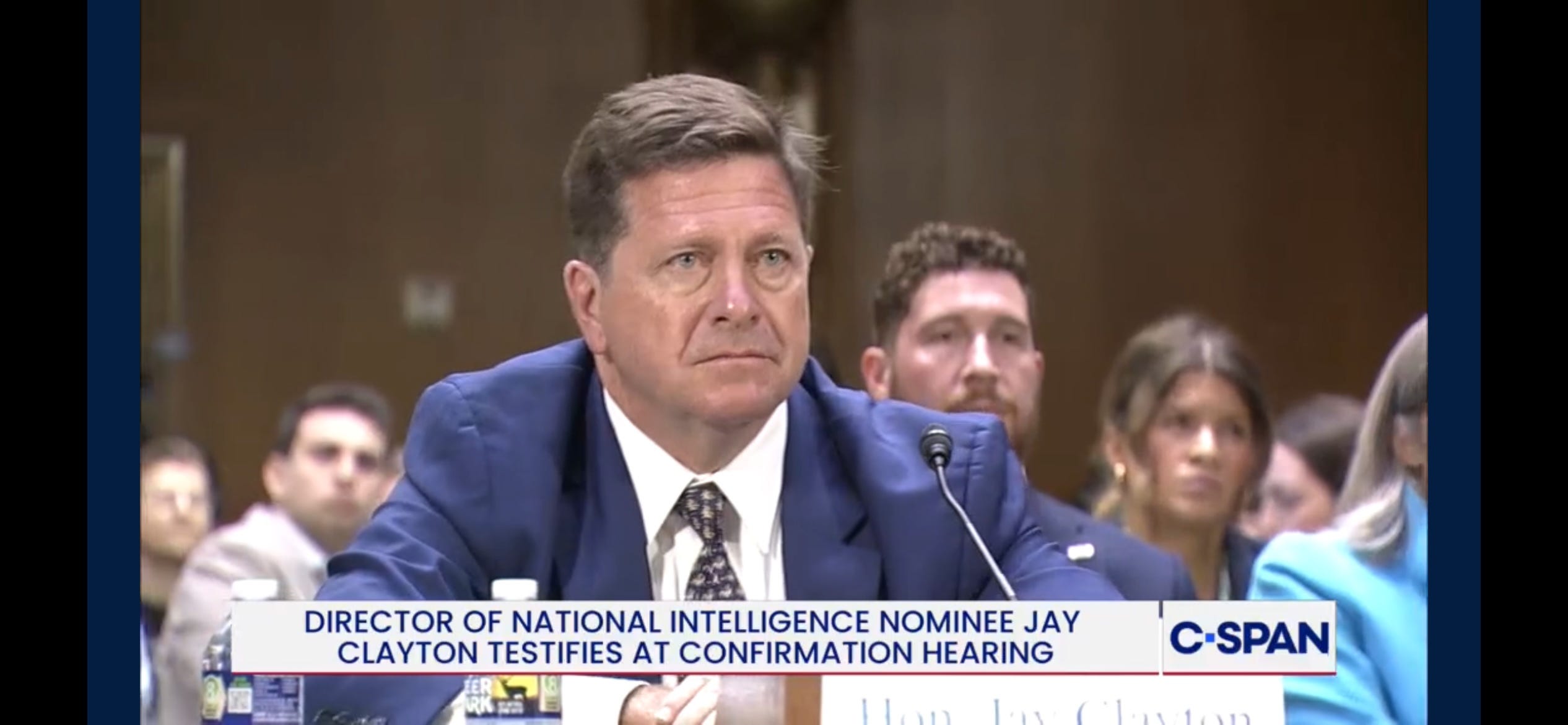
So everyone was playing their role, and the clock was running out when, exactly an hour and 46 minutes in, Sen. John Ossoff’s turn came. A camera moved in. The 39-year-old Georgia freshman, garnering quiet attention as potential presidential material, seemed to gather himself in a kind of cold, quiet Old Testament fury well beyond his age. He glared at Clayton.
“You have an obligation to be honest and forthright with this committee, correct?”
Clayton: “Yes.”
And then a surprise turn, a swerve away from who got elected how in 2020, to an overlooked moment in Clayton’s role as Manhattan’s top federal prosecutor.
“And is it the case in the Juan Orlando Hernández case that the President of the United States pardoned a man who had worked with the Sinaloa Cartel to facilitate massive narco trafficking into the United States?” Ossoff asked, totally out of the blue.
Bam. A left hook. Clayon was suddenly off balance. Hernández had been president of Honduras from 2014 to 2022, when he became the cocaine king of Central America, smuggling some 400 tons of the white powder into the U.S., investigators said. In 2024 he was extradited to New York, convicted in 2024 of drug and weapons charges, and sentenced to 45 years. Four months after Trump made Clayton head of the SDNY, Trump pardoned Hernández.
“We, we convict — right —a lot of people for a lot of drugs,” Clayton said. “I believe we just discussed that [before the hearing]. The president provided a pardon, yes.”
“Yes or no? Did the president. Of the United States. Pardon a convicted narco-trafficker?”
Clayton, fumbling: “Yes.”
“Who won the 2020 election?” Another left hook.
“You know, we’re not, I’m not, I’m not gonna do this with you. You’re telling me what I know. That’s kind of, um, I, he was, he was, I believe... I, I, look, I’ll take your word for it. He was a convicted narco trafficker.”
“Did the President of the United States, Donald J. Trump, pardon a convicted narco-trafficker?” Now a right jab.
Clayton: “I believe we just discussed that. The pre— the president provided a pardon, yes.”
“Yes or no? Did the president. Of the United States. Pardon a convicted narco-trafficker?”
Clayton: “Yes.”
“Who won the 2020 election?” Pow.
“You know, we’re not, I’m not, I’m not gonna do this with you.”
Ossoff cocked his head, looking quizzically at Clayton like he was an errant schoolboy. In his prior life as an investigative filmmaker, he might’ve learned it watching Mike Wallace skewer interviewees on 60 Minutes.
“This is a job interview,” he told Clayton. “We’ve established that you have an obligation to be — it’s a pretty interesting idea —be honest and forthright with the committee. Yes? You do have an obligation to be honest and forthright with the committee?
“Yes.”
“Who won the 2020 election?”
“Like I said, I’m not, I’m not gonna get into that with you.”
“But you do have an obligation to be honest and forthright with the committee. ..”
“Is anything that I just said not honest or forthright?
“Yes, you’re not being honest or forthright.”
“All right.” Clayton looked tired.
Ossoff: “Who won the 2020 election?”
“I think I’ve answered the question. We, we can keep doing this…”
Ossoff: “We’re gonna keep doing it because you’re not being honest and forthright with the committee.”
“No, I’m not gonna engage in—in the theater.”
“It’s a simple question, Mr. Clayton.”
“And I’ve answered it.”
“Who won the 2020 presidential election?”
Clayton stewed.
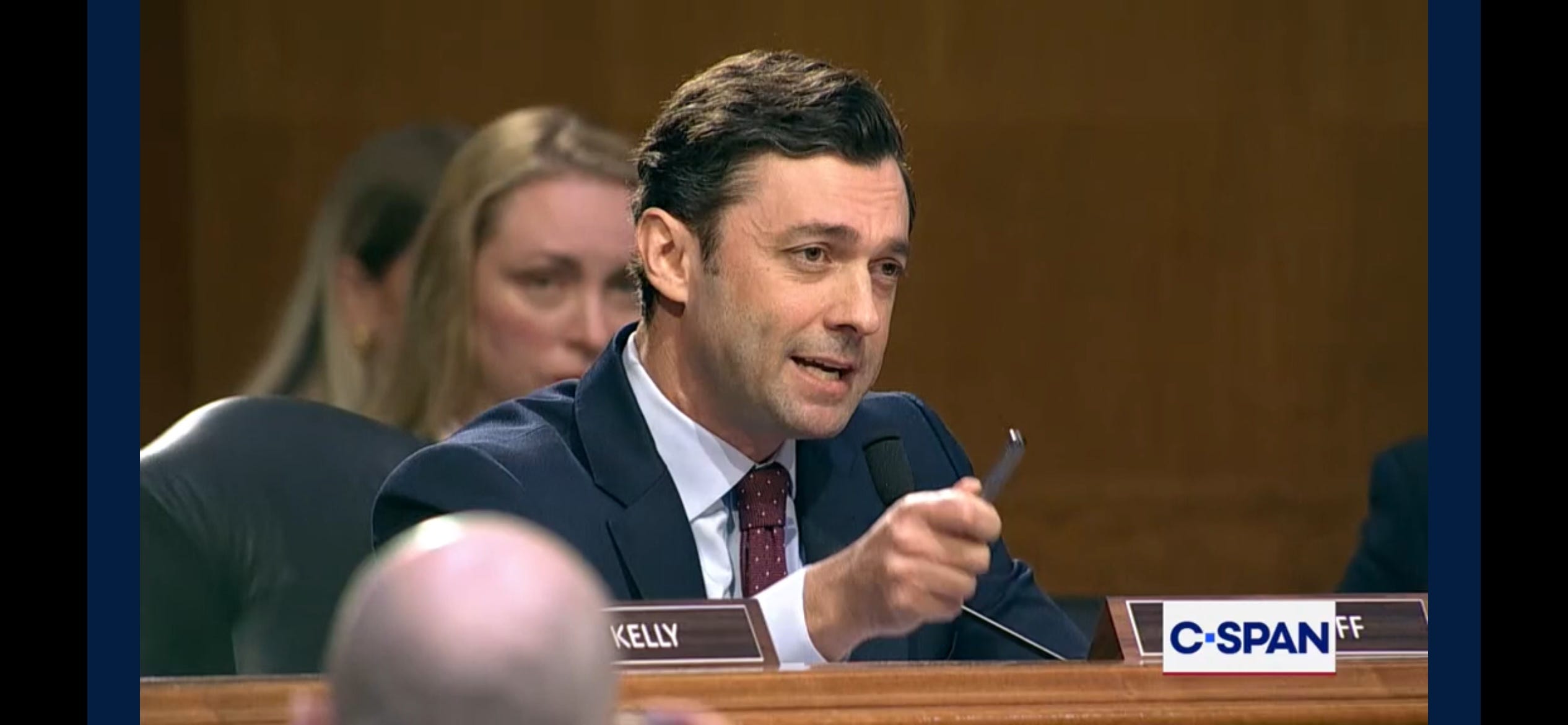
“Isn’t it humiliating to be unable to answer this question, to have to indulge the president’s delusions?” Ossoff asked. “We know, you know, everybody in this room knows the truthful answer to that question.”
And so forth. Whap, whap, whap. “Who won the 2020 election?” Again and again. It reminded me of Tom Cruise pressing Jack Nicholson in A Few Good Men.
“Who won the 2020 election?”
Except Clayton never cracked. There was not going to be a “You can’t handle the truth!” moment. Nicholson’s Col. Nathan R. Jessep lost his cool, career—and freedom— from blurting out his version of unit cohesion. Clayton wasn’t going to risk his by coming clean on the evil rot in Trumpworld.
Act 3
There was one last piece of business for Ossoff with Clayton—the DNI getting personally involved in domestic elections, well beyond its charter. The senator asked the nominee about Tulsi Gabbard traipsing down to Fulton County to “oversee” the FBI’s seizure of ballots.
Clayton said he’d never heard about it until now. The young Georgian looked at the witness with disbelief, then derision.
But then: “If the White House Chief of Staff or the President asks you to travel somewhere across the United States and oversee the execution of a domestic search warrant on a sensitive election facility, will you do it?”
“It’s a hypothetical,” Clayton said, leaving the door open.
That was all anybody needed to know.
Clayton had sold his soul to the devil, a story as old as time.
Good for Jon Ossoff. Bad for us that all of Trump's nominees are lying liars.