

High Level Beijing Purge Salted with Spy Allegation
Xi Jinping’s ouster of topmost general stirs fears of Taiwan grab


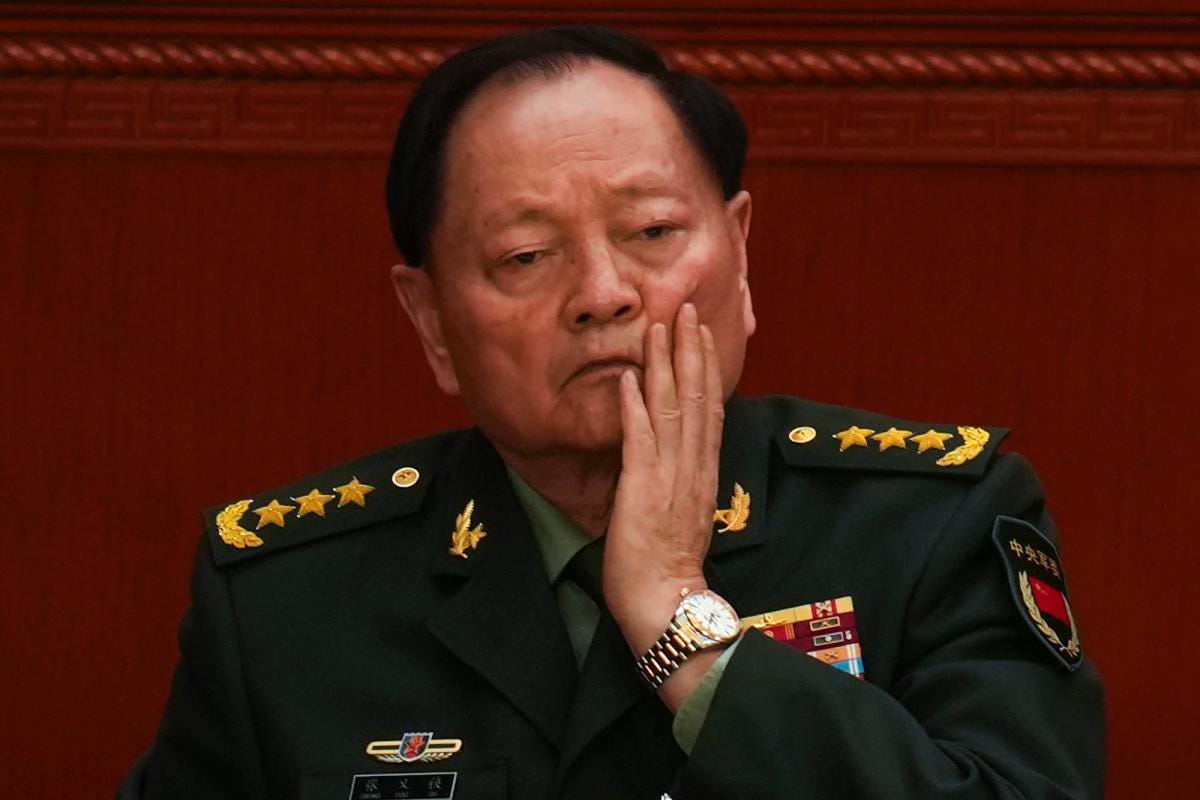
It seems like a plot drawn up for cable TV’s next international thriller, along the lines of Homeland or Tehran.
Two of China’s most powerful generals vanish from public view. The government quietly confirms that they are under investigation. Rumors ripple through the capital. A whiff of treachery is in the air. Fear of new purges spread.
This latest upheaval in Beijing is shocking, but it follows a longtime political script in Beijing, where communist bosses since 1950 have displayed a secretive ruling style that seems little changed since emperors once ruled China from behind the high walls of the Forbidden City. Last week’s military leadership purge, following the recent dismissals of other top generals, however, could have grave, contemporary consequences far beyond Beijing, particularly for the United States .
The abrupt removal especially of Gen. Zhang Youxia, a military official second only to President Xi JinPing, tops out “on an earthquake scale,” longtime China watcher John Pomfret says. It’s a “generational purge” unequaled across communist history, even exceeding Stalin’s purge of scores of generals in the 1930s.
But ground truth facts are hard to come by.
So let’s start with the one that is not in dispute.
China’s own Ministry of National Defense has publicly confirmed that Zhang, vice chairman of the Central Military Commission—the highest military authority in the country—and General Liu Zhenli, the officer responsible for operational planning of the armed forces, are under investigation for what Beijing calls “serious violations of discipline and law.”
Zhang, moreover, was a member of the ruling politburo and Xi’s most trusted military associate.
The Wall Street Journal exclusively reported that Zhang was also “accused of leaking information about the country’s nuclear-weapons program to the U.S…”during a “briefing—attended on Saturday morning by some of the military’s highest-ranking officers.”
It was a deliberate lie—disinformation—swallowed by the Journal, longtime experts consulted by SpyTalk said. The implication that Zhang was a CIA mole is not only far fetched but a falsehood manufactured by Xi’s minions to warn the defrocked general’s allies away from defending him.
As Bill Bishop, editor of the highly regarded Sinocism Substack site, put it: “Just because they may be telling other officials he leaked nuclear secrets does not mean he actually did. It might make for a useful charge internally, as it shows him to be an even greater villain than if he were simply corrupt.”
Likewise, Nicholas Eftimiades, the former CIA and Defense Intelligence Agency specialist who wrote the standard modern work on Chinese intelligence services, was categorical: “There is no likelihood Zhang was on anyone’s payroll.”
And Pomfret, a former Washington Post China correspondent, adds the historical frame: “The use of the state secrets allegation is basically pretextual,” he told SpyTalk, “because once there’s an allegation you released state secrets to foreigners, you become immediately impossible to support.”
In any event, the upheaval is profound. Zhang was not a provincial commander, not a second-tier figure. This was a toppling at the summit of the military pyramid.
The closest American equivalent would be the chairman of the Joint Chiefs of Staff and the officer responsible for United States war planning being removed at the same time.
