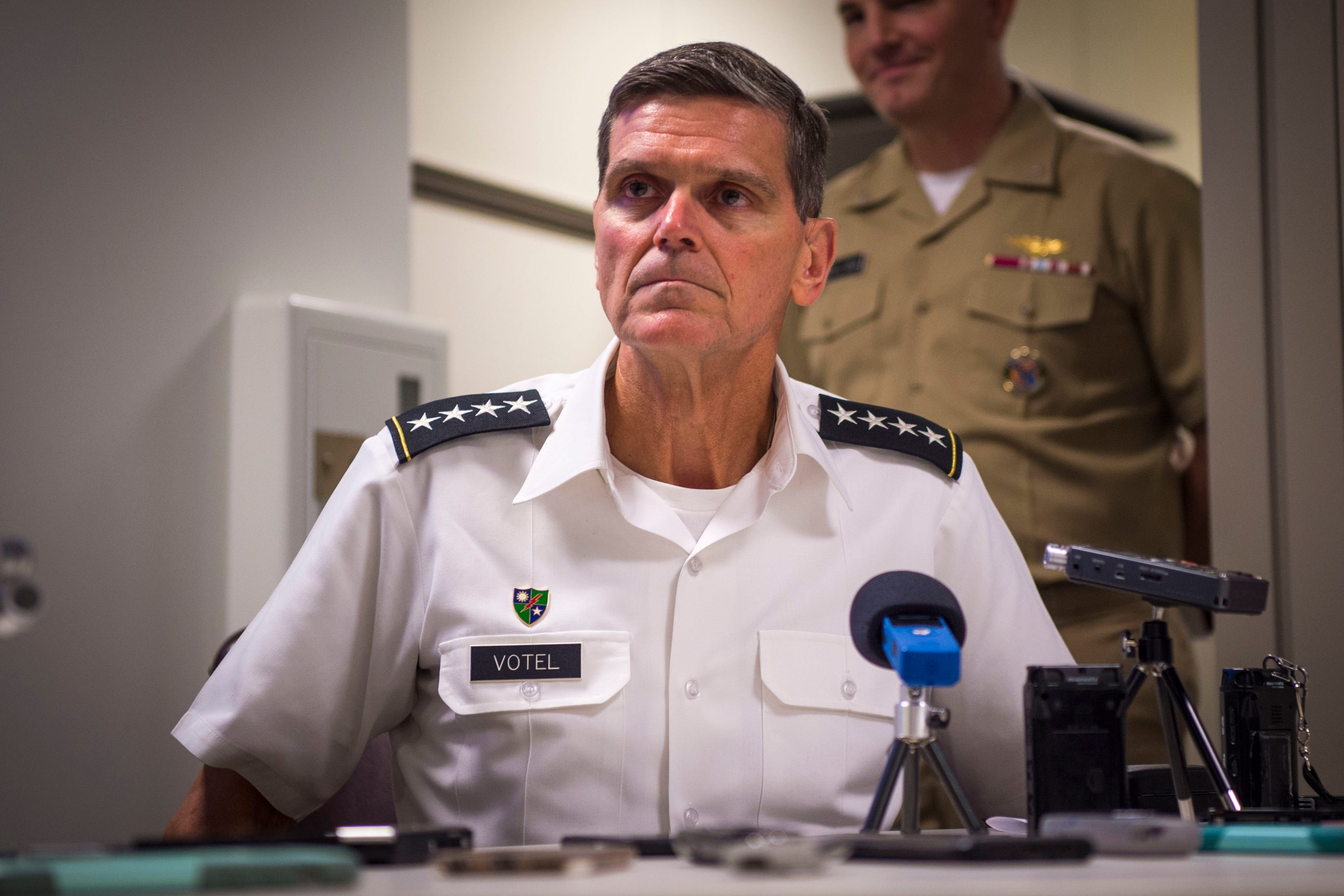
Former CENTCOM Commander Advises Military Commanders to Refuse “Illegal” Orders
Retired Gen. Joseph Votel calls Trump’s threats to destroy Iranian civilization “shocking”
A former chief of the U.S. Central Command in the first Trump administration says the president’s threats to bomb Iran back to the Stone Ages is “shocking” and advised U.S. military officers to refuse to carry out “illegal” orders for air strikes that would primarily destroy civilian infrastructure.
The comments by retired four-star General Joseph Votel on the SpyTalk podcast were among the strongest criticisms yet from a former senior military officer about Trump’s rhetoric in the current Iran conflict. They were especially notable given that Votel, as CENTCOM chief from 2016 to 2019, oversaw the Trump administration’s successful military campaign against the Islamic State.
Although normally reserved and cautious in his public comments, Votel, 68, didn’t hold back when asked about Trump’s statement during his nationwide speech last week that if Iran doesn’t yield to U.S. demands, “we are going to bring them back to the Stone Ages, where they belong.”
“It’s a shocking statement, I think, to come from the president of the United States,” Votel said, noting that the country’s leaders didn’t even use such rhetoric when demanding that Germany and Japan unconditionally surrender during World War II.
Despite the fragile ceasefire announced this week and the upcoming U.S.-Iran talks slated for this weekend in Pakistan, Trump hasn’t dropped his blustery threats to blow up Iran’s bridges, power stations and other infrastructure.
“A whole civilization will die tonight, never to be brought back again,” Trump said in a Truth Social post Tuesday. Then, in another late night Truth Social post Wednesday night, Trump said all U.S. ships, aircraft and military personnel needed for the “lethal prosecution and destruction” of Iran would remain in the region until a “REAL AGREEMENT” is reached that meets U.S. demands that the country’s leaders abandon its nuclear program and reopen the Strait of Hormuz.
“If for any reason it is not, which is highly unlikely, then the ‘Shootin’ Starts,’ bigger, and better, and stronger than anyone has ever seen before,” Trump wrote on Truth Social at 11:46 p.m.
(On Friday, as Vice President Vance was taking off for Pakistan for talks with the Iranians, Trump threatened again what he’ll do if the negotiations don’t yield fruit in the next 24 hours. “We’re loading up the ships with the best weapons ever made even at a higher level than we use to do a complete decimation,” he told the New York Post.
Such comments, coming after Trump’s threats that “all Hell will reign down on them,” present U.S. military officers ordered to carry out such actions with an excruciating dilemma, as Votel made clear.
When he considered ordering airstrikes as CENTCOM commander, Vogel said, “we would execute the process that we have for selecting targets” and examine “very, very closely” whether they were legitimately “dual use” or largely for civilian purposes. If they were not “principally benefiting the military,” he would “take the time to talk to the secretary and leadership about that.”
Votel was asked, if a defense secretary responded with, “the president wants this— do it anyway,” what would he do?
“Well then, if that’s the case, if at that time I don’t agree with that, then my option is to step aside.”
In fact, Votel added, that would be a decision that any U.S. military officer would be required to take.
Oaths of Office
“I think that’s the obligation of any officer—when he or she can no longer…execute the orders that are being passed to them because, in his or her estimation, they’re illegal,” said Votel, “that’s what you must do.”
Votel’s comments, in a sense, reaffirm the advice that six Democratic lawmakers gave in a controversial video last November, telling U.S. service members, “Our laws are clear. You can refuse illegal orders. No one has to carry out orders that violate the law or our Constitution.”
The video— which included remarks by Senators Mark Kelly, a former Navy captain and astronaut, and Elissa Slotkin, a former CIA officer–infuriated Trump administration officials. Federal prosecutors tried to indict the lawmakers for encouraging “insubordination” and “mutiny,” only to have a Washington, D.C. grand jury reject the proposed charges, forcing the Justice Department to drop the case.

Vogel is by no means a critic of the war effort itself. Irrespective of the initial decision to launch the campaign against Iran, “we are where we are today,” he said: The U.S. can’t walk away from the conflict leaving Iran “in a kind of emboldened position…We have to stay strong. We have to be able to be willing to back up our negotiation process with a credible military threat here.”.
But Votel also warned that some of what remains to be done by the U.S. military could carry enormous risks. As chief of the U.S. Special Operations Command prior to taking over CENTCOM, Votel was especially focused on options for seizing the 440 kilograms of enriched uranium that Iran is believed to have buried in the mountains where its nuclear facilities were.
Votel said “it is a doable mission,” but a significant one that’s “going to take time”— possibly weeks to complete— and “it’s likely that there’s going to be casualties.”
“We’ve got to be able to put people on the ground,” Votel said. “We’ve got to be able to protect them. We’ve got to be able to sustain them. We’ve got to be able to get all of that out. We’ve got to be able to bring in the equipment to dig down and recover this stuff, maybe at multiple sites. So it’s a significant operation. “
But, he then asked, “is our political leadership ready to accept the ramifications, the risks that come along with this?” For all of Trump’s bluster and bombast, that remains very much an open question.


