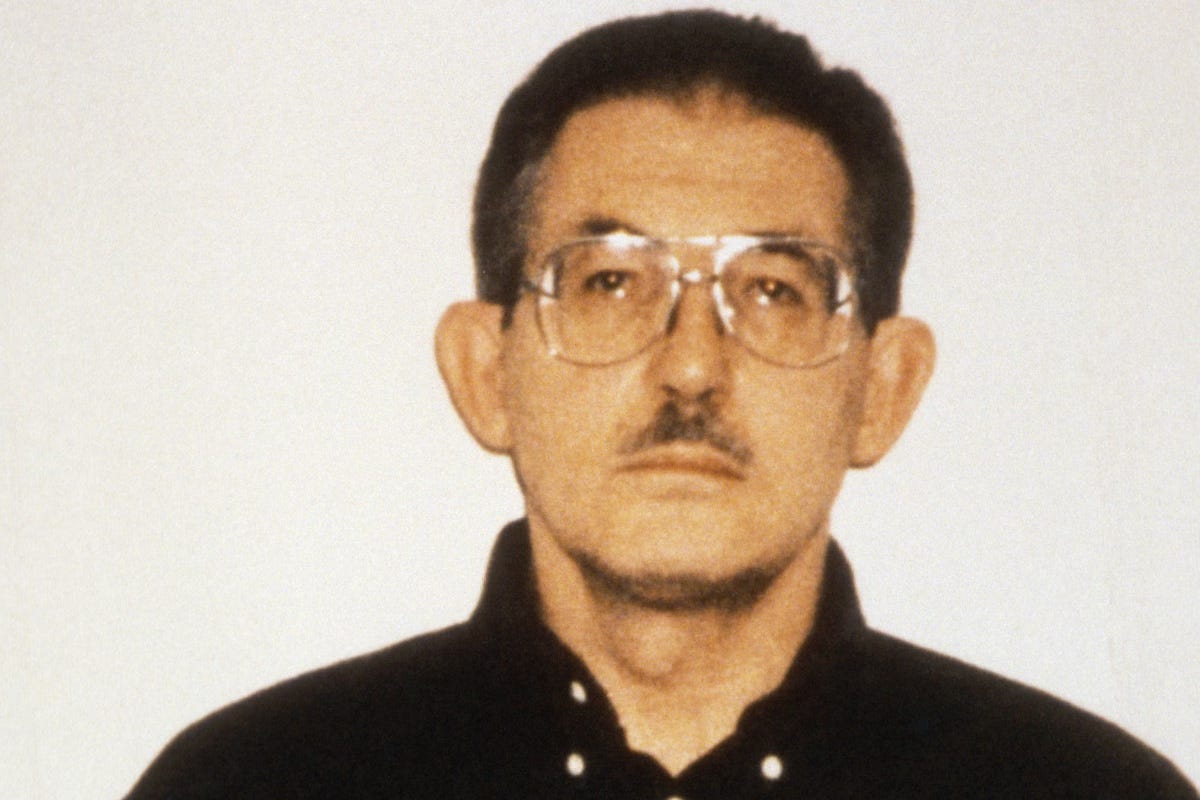
Aldrich Ames and Me
Former senior CIA officer Colin Thompson remembers the notorious turncoat
Aldrich Ames, age 84, former CIA officer, died January 6, 2026, in prison, his home of record since shortly after his conviction on espionage charges in 1994. The cited cause was lung cancer. Ames had been a smoker for many years (like most of us) and was still one when I first met him in 1983 and for years after. The federal prison system’s prohibition of tobacco in 2006 probably caused him some distress, which probably no one who knew of him would be sorry to hear. I have a small measure of sympathy for him, very small, but he was a human being.
In any case, Ames is dead, but too long after his treason had caused the death of about 15 Soviet citizens whom he’d betrayed as American agents. To the Kremlin, the punishments fit the crimes, but I don’t think Ames really cared.
Ames finished a two-year tour in Mexico City in 1983, then returned to Washington to take up a position in the Soviet East European (SE) Division as chief of the section charged with counterintelligence for Soviet cases, a job I was lined up for. The supervisor, only recently arrived, told me straight out that he knew Ames, not me, and that Ames had done some good work in New York helping Arkady Shevchenko, the most senior Soviet diplomat in New York, defect to the U.S. This was eight years before Ames offered his services to the KGB.
So, Ames got the more prestigious position and I got Eastern Europe. Ames and I worked well enough together, and the work group we were part of functioned efficiently. There was no social connection between us, however. My recollection is that we never even once ate lunch together in the building cafeteria. The food was no incentive either. Nor do I recall ever meeting him for a drink after work or otherwise socializing with him.
It was during this period that Ames acted on his decision to betray his country, to volunteer his services to the KGB and the Soviet Union. I didn’t have a clue that this was coming. Yes, Ames complained about his financial situation. It wasn’t good. He was in the midst of divorcing his wife, who lived in New York City—an expensive place, nothing like Mexico City, where he’d recently served and the living was easy, what with the U.S. government covering so many costs and enabling us to live well and play at will. Now he was home again, paying stateside prices. And he announced he was in love again, with plans to bring the woman, Rosario Casas Dupuy, an employee of Colombia’s embassy in Mexico, to the U.S., set up house and marry her.
How many times had I heard tales like this? I mostly ignored them because they were common, a fact of life for CIA (and other) government employees returning from overseas duty. Belts might have to be tightened to solve money shortages. An easier way was to secure another overseas tour as quickly as possible. Security personnel view money problems as a possible vulnerability that could be exploited by the KGB and other hostile services. On the other hand, I saw nothing unusual about Ames’s talk of financial woes. Neither did any other serious observer, at least not without substantially more suspicious data in hand.
I was somewhat surprised to learn one afternoon that Ames was not a fan of Ronald Reagan, then president, and that he quite strongly opposed the idea that “greed is good,” as Reagan reportedly felt. Now there’s a dose of irony for you. The general public and the media tend to group the CIA with Republicans (or at least Republicans of yore). Ames did not belong in that group. Nor do I or many more Agency employees. Did Ames’ distaste for Reagan make him vulnerable to Soviet beliefs? I doubt it. Money was his main motivation.
“Financial troubles, immediate and continuing,” Ames said “matter-of-factly,” according to an obituary by veteran national security journalist Walter Pincus in The Washington Post. The turncoat also didn’t think the spy game added up to much. Again, Pincus: “These spy wars are a sideshow which have had no real impact on our significant security interests over the years.” Ideology didn’t color his views, either. He continued to spy for the Kremlin after the USSR dissolved in December 1991.
The KGB was known to have paid Ames more than two million dollars and to have promised his son (who must be close to 40 years old by now) another two million or so.). Ames must have known approximately what he was worth to the Soviets, but even if he wasn’t so greedy, why pass up a major chunk of cash that was there for the taking? He took the money and ran, of course, saving us at least the agony of searching for his motivation.
I was somewhat surprised to learn one afternoon that Ames was not a fan of Ronald Reagan, then president, and that he quite strongly opposed the idea that “greed is good,” as Reagan reportedly felt. Now there’s a dose of irony for you.
Ames married Rosario in August 1985. The wedding was in a small church on a hill in suburban Virginia. I attended, as did my date, an agency woman, and two or three other CIA employees, also women. All other attendees were relatives of Ames and Rosario, and after the ceremony, the relatives gathered by the church for the traditional taking of photos, while the remaining guests, we CIA types, were left to roam the far side of the hill. Very pleasant, really, sunny but not hot. I wondered: Where were all the friends that Ames should have had? He had been an SE hand for many years, much longer than I had, yet so few of these colleagues were present.
The reception was the equivalent of an afternoon tea, not exciting and not costly. Years later we learned that the Soviets had paid Ames $50,000 in cash a couple of days before the wedding. The money was certainly not spent on the reception. Perhaps in Colombia, Rosario’s home country, the tradition is for the bride’s parents to pay for the shindig. Soon enough, however, Ames showed signs of new money, such as the shiny new Jaguar parked in the headquarters lot. Nobody took much notice, or of his cash payment for a new house, both of which, he claimed, were the fruits of an inheritance from Rosario’s rich Colombian relatives. But his new prosperity finally caught someone’s attention—one of the CIA women who attended the wedding—and Ames’s role as KGB agent began to unravel. The mole hunters’ probe was very closely held.
In the meantime, Ames and I occupied offices next door to one another on the fifth floor of what is now the old CIA Headquarters Building, which opened for business just across the Potomac River from Washington in1962. Our windows looked out over the front entrance of the building to a wooded area that eventually led down to the Potomac. No river view, however: Too many trees. His office was situated so that the door to it opened to a wall, meaning that you could not see into the office without actually coming through the doorway. From there I would see him at his desk--one of those old gray government jobs just like mine--feet up on it, cigarette nearby, reading a file in a government-issue, khaki colored folder, a shade common in the 1950s onward. The rest of the desk was usually covered with a stack or two of more khaki-colored folders containing the documents of old cases, the histories of recruited Russians (always men) who had cooperated with the CIA as penetrations of the KGB and GRU, the Soviet military intelligence service. As we would learn all too late later, Ames would remove and walk out of the building with them and bury them in dead drops in local parks to be picked up by KGB officers stationed in Washington Then they were on to Moscow and KGB Headquarters. Some of this information was used to expose to the KGB the names and information on Soviets who had been recruited by the CIA. Many of the individuals were investigated, arrested, interrogated, beaten, humiliated and executed, shot dead.
Did it occur to me that Ames’s purpose in reviewing these old files might be to pass information in them along to the KGB? No. Ames was authorized to read them and that summer of 1985 was slow in SE Division. The weather was hot and sticky, as usual, but there just wasn’t much going on. Reading old files was one way to occupy the work day, and Ames did not seem to me much inclined to work hard. He often returned to work after liquid lunches. He needed to at least look busy.
This summer idyll came to an abrupt end on the last day of that July. A KGB colonel named Vitaliy Yurchenko walked into the American Embassy in Rome and declared he was defecting to the U.S. CIA Headquarters was immediately notified and in barely over three hours, Yurchenko was being driven from the embassy to a plane waiting to whisk him to Washington via Frankfurt, Germany. While Yurchenko was airborne, Ames was named head of the Yurchenko task force and told to be at the air base, now known as Joint Base Andrews, the next morning, August 1, to meet and greet Yurchenko.
Two FBI special agents were to join Ames as members of the official greeting party. Was it possible that Yurchenko knew Ames was a KGB agent? Was Ames about to be exposed and arrested, jailed for life or even executed? Did Ames sleep well that night? At that point, he’d been selling secrets to the KGB for three years. People who saw him at the arrival said he looked unkempt and disheveled (not altogether unusual), as if he’d had a few the night before. He may have also looked distressed. But Yurchenko knew nothing of Ames, it would turn out—-the KGB had protected knowledge of Ames’s role to an extraordinary degree.
Later that morning I was added to the Yurchenko task force as his handler and debriefer. Less than three weeks later, Ames announced that he was being assigned to the Rome Station and would start Italian language training almost immediately. [Was he under suspicion at that point?] I saw him a time or two in the hallways at CIA Headquarters before he was on his way to Rome, Rosario in tow, Then Yurchenko re-defected, walking away from our minder in a Georgetown restaurant and up the hill to the Soviet embassy. Even though I’d repeatedly warned my superiors that heavy handed guards from the Office of Security were treating him too roughly, my name turned to mud. I last saw Ames in 1992 at a garden party given by a colleague. He seemed delighted to see me.
This time, he was dressed like an Italian movie star. He looked quite dapper. We would soon learn why. Less than two years later, he was outfitted in prison garb.
Colin Thompson is a former senior CIA clandestine services officer whose 28 years of duty included tours of duty in Southeast Asia, in Soviet counterintelligence and other operations in Washington, D.C.


In his 2014 article, "Ghosts of the Spy Wars," Tennent H. Bagley wrote, "A KGB veteran thought that 'most' of the CIA spies inside the KGB who were betrayed by CIA traitor Aldrich Ames in 1985 were in fact loyal staffers pretending to help the CIA." (Aleksandr Kouzminov, Biological Espionage: Special Operations in the Soviet and Russian Foreign Intelligence Services in the West (London: Greenhill Books, 2005), p. 59.) Also, Vitali "Homesick" Yurchenko was a false defector sent to the U.S. to protect a mole or two in the Agency from being uncovered.
Very interesting. I would love to understand how it is so easy for people in Intelligence to get away with betraying the US government. I understand that he walked out with files, but did he copy them or who was in charge of keeping track of them that he did not. I see how easily Donald Trump was able to take US files. I see he could be giving that intel to the FSB right now. It does not seem like the accountability for files is so high.