

A Few Intelligence Nuggets Emerge in Newly Released Documents
China stepped up espionage, hacked Biden campaign, but didn’t engage in 2020 election interference, despite Trump claims. (Russia did—again.)

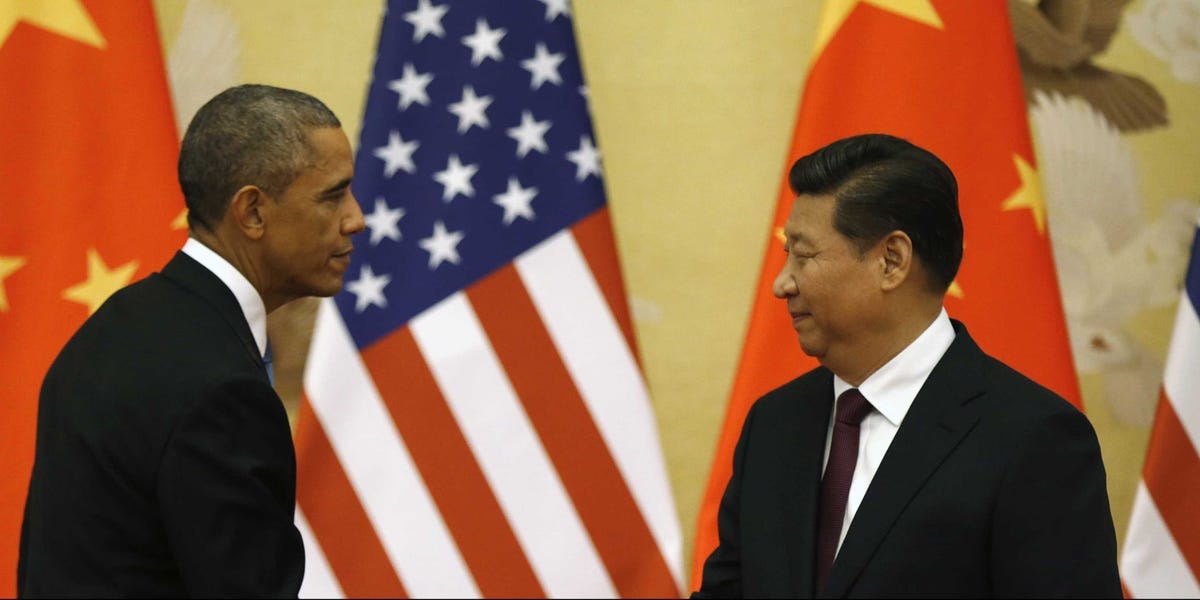
Barack Obama was stunned.
“You got to be kidding me!” the then-U.S. senator from Illinois said when he was told, in the summer of 2008, that his presidential campaign, and that of his rival, John McCain, had been hacked by a foreign “entity.”
The cyber heist of both campaigns’ computer systems was first reported by Newsweek that fall in a special post-election edition and was considered a significant, and somewhat spooky, revelation at the time.
But it wasn’t until five years later that I confirmed what was widely suspected from the outset: the hacks came from cyber warriors associated with the People’s Republic of China—the culprits in what Dennis Blair, Obama’s first director of national intelligence, called a “case of political cyberespionage by the Chinese government against the two American political parties.”
As the French say, “Plus ça change, plus c’est la même chose.” The long ago 2008 cyber attack has taken on new relevance in light of President Trump’s much hyped speech Thursday night revealing that the Chinese had actually stepped up their election espionage game since then, hacking into and acquiring voter registration records on more than 220 million Americans, including names, addresses, phone numbers and party affiliation during the 2000 presidential campaign between him and Joe Biden.
That, and much more, was revealed in a cache of newly declassified intelligence documents released on the White House website as Trump was delivering yet another baseless attack on elections security.
But there were some fresh, albeit deja vu nuggets: Just as in 2008, the Chinese hacked into the 2020 presidential campaign of Joe Biden, “probably to gather intelligence that could enable future operations,” reads a newly declassified CIA World Intelligence Review dated July 1, 2020. (The Chinese hack of the Biden campaign does not appear to have been previously reported.)
Some of the new material — but not the Chinese hack of Biden’s campaign — was invoked by Trump as supposedly fresh evidence that America’s electoral system had been compromised and that drastic action — most notably passage of his hotly controversial legislation requiring prospective voters submit citizenship papers in order to register to vote — was needed to ensure an honest vote count. Starting, of course, with this year’s mid-terms.
“We can never be hacked, and we can never watch a stolen election again,” proclaimed Trump.
In fact, there is nothing in the newly released intelligence reports and emails that suggests China—or any other foreign power—tampered in any way with actual vote counts, thereby disappointing MAGA influencers (and no doubt Trump himself) that the president’s repeated claims to have been the victim of a “stolen” election would be vindicated.
The intelligence reports say precisely the opposite, emphasizing there was zero evidence that the Chinese even sought to influence the electoral outcome. “Beijing did not intend to try to affect the election,” states an Aug. 19, 2020 report from the National Intelligence Council entitled “Foreign Threats to 2020 U.S. Federal Elections.” Added the CIA’s “World Intelligence Review” from that summer: “The [Intelligence Community] assesses that China does not currently intend to covertly interfere to try to sway the outcome of the election, although this activity could enable such operations.”
There is nothing in the newly released intelligence reports and emails that suggests China—or any other foreign power—tampered in any way with actual vote counts.
But Trump’s malicious hyperbole aside, that doesn’t mean the newly declassified records should be ignored or dismissed. The idea that the Chinese government had assembled a vast data base with personal information on hundreds of millions of Americans is unsettling, to say the least (even if in some states those voting records are actually public.) And it certainly fits with much else we know about Chinese cyber intrusions.
Record of Thefts
In 2015, it was disclosed that Chinese hackers had broken into the computers of the U.S. government’s Office of Personnel Management, scooping up Social Security numbers and other personal records on 22 million government workers. In 2017, Chinese military hackers infiltrated the computers of Equifax, the personal credit agency, retrieving personal data on 145 million Americans in what was described by the Justice Department as “the largest known theft of personally identifiable information ever carried out by state-sponsored actors.”
But to what end? There is, of course, no end to the mischief the Chinese could undertake — blackmail, coercion, spy recruitment — by having personal data on virtually every American.
As for its election-related cyberattacks, back in 2008, U.S. officials believed the Chinese were seeking to track the emails and assess the views on China policy of key campaign staffers for Obama and McCain, knowing that one or the other of them would soon be moving into senior policy positions in the next administration. (And as I revealed in my 2013 story for NBC News, some of the hacked campaign documents were indeed sensitive, including a private letter that McCain had written to the new president of Taiwan.)
The newly released records posted on the White House website show that the fear that the Chinese will use its hacked material for espionage recruitment has been a constant and apparently growing concern. The Chinese hacker group, known in the trade as “APT31,” had a practice “of sending tracking links” that “suggests that the Chinese operators are mapping out the target network for follow-on approaches, possibly including tasking campaign staffers’ email accounts in the Chinese military’s signals intelligence system for collection,” states the declassified July, 2020 CIA World Intelligence Review. “Tracking links collect metadata such as Internet activity and system information that the operators can use to export the accounts and identify other targets of interest.”
All of which means the newly released material does indeed reveal legitimate intelligence concerns. But there is much else in the declassified records that Trump never mentioned during his Thursday night speech, for obvious reasons.
Moscow Again
Remember for a moment— because Trump has never forgotten— Russia’s outrageous attempt to interfere in the 2016 election in ways that indisputably helped him and harmed his Democratic opponent that year, Hillary Clinton. The Russians hacked the Democratic National Committee’s internal emails and then released them through WikiLeaks on the eve of the DNC convention in Philadelphia, throwing the event into chaos and prompting the resignation of the party’s chairman. Then it hacked into the Clinton campaign’s computers and once again laundered them to the public through WikiLeaks, torturing the Clinton camp with selective, embarrassing releases during the final weeks of the campaign.
All this led to a public uproar and in due course a special counsel investigation by the late former FBI Director Robert Mueller that Trump spent years complaining about as “the Russia hoax.”
While all this was front page news in 2016 as well as the several years that followed, there was something else the U.S. intelligence community picked up in 2020 that never made it into the newspapers: the Russians were doing the very same thing once again.
“We assess that Russia is using a range of measures primarily to denigrate former Vice President Biden and what it sees as an anti-Russia establishment,” the National Intelligence Council report from August 2020 stated. “For example, it is directing or encouraging proxies to spread claims about Vice President Biden. Some Kremlin-linked actors are also seeking to boost President Trump’s candidacy on social media.”
As the French say…”plus ça change...”
I have seen reports of Chinese printing many "fake ID cards" and the notion that they could be used to affect elections in the USA. If so, it might make sense for those in the USA that want to fix an election with fraud to limit states from using more advanced ways to identify registered voters when voting. They would force states to rely on cards. Who would do that? Maryland has a system that I believe is superior than an ID card. Can it keep it?